Celt History
Origin of the Celts
The Celts are an indigenous people from Lusitania in South Western Europe by the Atlantic Ocean and were in ancient times known as Lusitanians in their own language.

Continuous human settlement in Lusitania dates back hundreds of thousands of years from the Pleistocene to the Neolithic Period of 12000 BC, to the Atlantic Bronze Age of 1300 BC and to modern times.
Historical Accounts of the Celts
Herodotus, since antiquity described as the father of history, in his 430 BC book Histories, placed the Celts as living in the extreme west of Europe beyond the Straights of Gibraltar by the Atlantic Ocean in what is modern day Portugal – known in ancient times as Lusitania.
“The Celts live beyond the Pillars of Hercules, and border the Cynesians who dwell at the extreme west of Europe.” Herodotus, The Histories, book 2, chapter 33
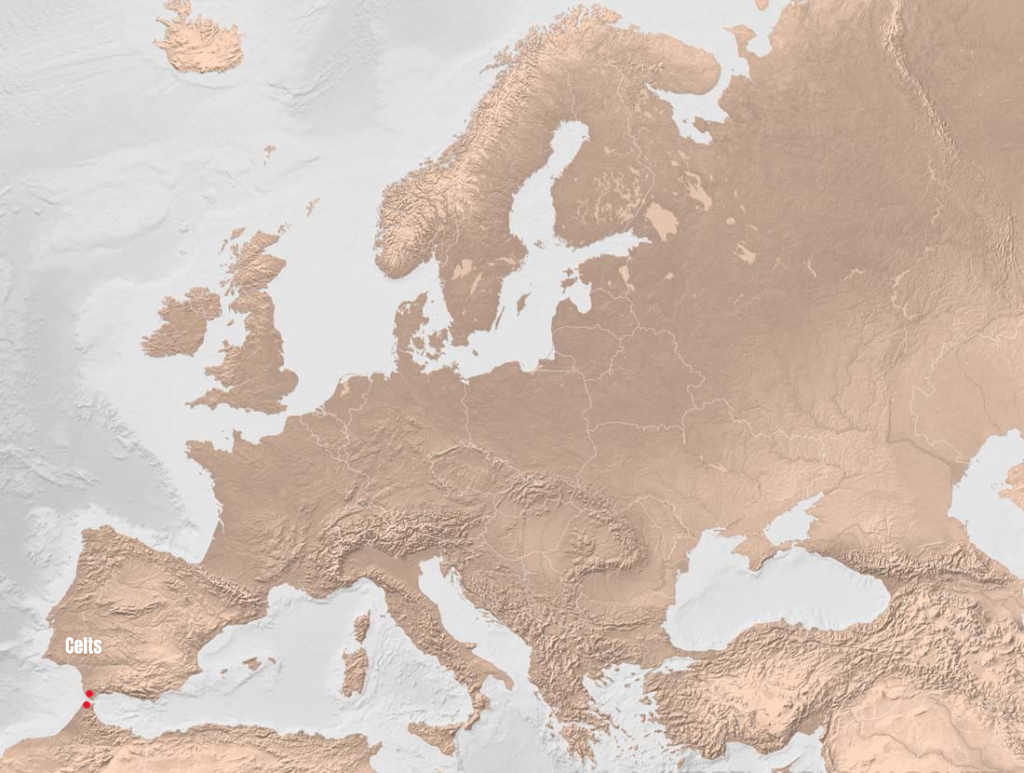
Avienus, in his 6th-century BC based Ora Maritima, when describing the lands beyond the Pillars of Hercules places the Celts in this same region.
“for by the hand of the Celts”Avienus, Ora Maritima, 130
In the 150 A.D Geographia, an ancient atlas written by Claudius Ptolemy, when describing several cities of the Celts in Lusitania, Claudius states:
“The Celts inhabit that region which from these cities lies toward the interior; their cities in Lusitania are Laccobriga, Caepiana, Braetoleum, Mirobriga, Arcobriga, Meribriga, Catraleucus and Arandis.”Claudius Ptolemy, Geographia, book 2, chapter 4
When describing Lusitania, Strabo states the capital of the Celts was Conistorgis.
“In the country of the Celts, Conistorgis is the best-known city but on the estuaries Asta is the best known,”Strabo, Geographia, book 3, chapter 2,2
Conistorgis was located in the interior of Algarve, in southwestern most Portugal. Strabo places the land of the Conii, also known as Cynetes, between the river Anas, modern day Guadiana River and the Sacred Promontory – the southwestern most point of Lusitania – modern day Portugal.
The first century geographer Pomponius Mela, describes the Lusitanian Atlantic coastline – modern day Portugal and Galicia, as the “Celtic coast”.Pomponius Mela, De situ orbis, book 3, chapter 47
The kingship of Celtic peoples from the southern Lusitania, modern day Portugal to the north in Galicia is evidenced by:
“Last of all come the Artabrians, who live in the neighbourhood of the cape called Nerium, which is the end of both the western and the northern side of Iberia. But the country round about the cape itself is inhabited by Celtic people, kinsmen of those on the Anas”Strabo, Geographia, book 3, chapter 3.5
Portugal means Port of the Gauls and Galicia means Land of the Gauls, where Gauls is the Latin term for the Greek word – Celt.
The 1st Century AD historian, Lucius Annaeus Florus, when describing ancient Iberia names, the Lusitanians as a Celtic people.Lucius Annaeus Florus, Epitome of Roman History, book 1, chapter 33
That the Gauls were originally known as Celts is attested by Ammianus Marcellinus where he wrote:
“Ancient writers, pursuing their investigations into the earliest origin of the Gauls, left our knowledge of the truth very imperfect; but at a later period, Timagenes, a thorough Greek both in diligence and language, collected, from various writings facts which had been long unknown, and guided by his faithful statements, we, dispelling all obscurity, will now give a plain and intelligible relation of them.
Some persons affirm that the first inhabitants ever seen in these regions were called Celts, after the name of their king, who was very popular among them, and sometimes also Galatæ, after the name of his mother. For Galatæ is the Greek translation of the Roman term Galli.”Ammianus Marcellinus, Roman History, book 9, Chapter 2-3
Other Celt peoples of Lusitania were the Cantabarians, Carpetanians, Vettonians, Vaccaeans, Artabrians, Asturians, Cynesians, Cynetes, Conii, Turduli, Turdetanians, Tartessians and Galicians.
Strabo states:
“Lusitania is the greatest of the Iberian nations, and is the nation against which the Romans waged war for the longest times.”Strabo, Geographia, book 3, chapter 3.2
The Celtiberians were another Celt people bordering on the east of the Lusitanian people. Pliny the Elder believed the ancestral home of the Celtiberians was in the territory of the Celts in the south west of Lusitania and Strabo viewed the Celtiberians as a branch of the Celts from Lusitania.
“It is evident that the Celts have sprung from the Celtiberians, and have come from Lusitania, from their religious rites, their language, and the names of their towns”.Pliny the Elder, Natural History, Volume1, Book 3, chapter 3
“The Celts who have added to their name that of the Hiberi came also. To these men death in battle is glorious; and they consider it a crime to burn the body of such a warrior; for they believe that the soul goes up to the gods in heaven, if the body is devoured on the field by the hungry vulture. Rich Galicia sent her people, men who have knowledge concerning the entrails of beasts, the flight of birds, and the lightnings of heaven; they delight, at one time, to chant the rude songs of their native tongue, at another to stamp the ground in the dance and clash their noisy shields in time to the music…These men, and the Lusitanians drawn forth from their distant forests, were led by the young Viriathus.”Silius Italicus, Punica, Book 3, chapters 330-356
A recently discovered Celtic town by the Atlantic Ocean in Lusitania has been found in the translation of the Artemidorus Papyrus.
In col. v 32 of the Artemidorus papyrus a previously unknown town, called Ipsa, is placed, according to a possible reconstruction, to the West of the estuary of the river Baetis (modern Guadalquivir) and of the town Ossonoba,
We know Ossonoba was a Celtic town from both Pliny the Elder and Pompinus Mela.
“But Lusitania, beyond the Ana, where it faces the Atlantic sea, first goes out into the deep with immense thrust, then halts and withdraws itself even more than Baetica. Where it juts out, after the sea has twice been taken back into itself, it spreads into three headlands: the one nearest the Ana, because it runs out with a broad base and gradually narrows itself and its sides, is called the Cuneus Field; the next they call the Sacred; the farthest is called the Great. In the Cuneus are Myrtili, Balsa, Ossonoba; in the Sacred are Caetobriga and the Harbor of Hannibal; in the Great is Ebora. There are bays: and close by is Salacia, on the other side Ulisippus and the mouth of the Tagus, a river that produces gems and gold. From these headlands, on the side which curves inward, a vast bend opens up, and in it are the Old Turduli and the towns of the Turduli; the rivers, however, that flow out nearly into the middle of the side of the last promontory are the Munda, and the Durius, which washes the roots of that same promontory. That front has for some distance a straight shore, then, after taking a slight bend, soon projects a little, then, drawn back and again lying with a straight margin, it extends to the promontory which we call Celtic. The whole of it is inhabited by the Celts.”Pomponius Mela, De situ orbis, book 3, chapters 4-7
“The peoples are the Celts, the Turduli, and, about the Tagus, the Vettones. From the river Anas to the Sacred Promontory are the Lusitanians. The cities worthy of mention on the coast, beginning from the Tagus, are that of Olisipo, famous for its mares, which conceive from the west wind; Salacia, which is surnamed the Imperial City; Merobrica; and then the Sacred Promontory, with the other known by the name of Cuneus, and the towns of Ossonoba, Balsa, and Myrtili.”Pliny the Elder, Natural History, book 4, chapter 35
The existence of this Celtic town Ipsa in modern day Portugal is further evidenced by the 1986 discovery of some 1st century BC bronze coins bearing the inscription IPSES. They were found in excavations in Alvor, a coastal town in the Algarve, Portugal.
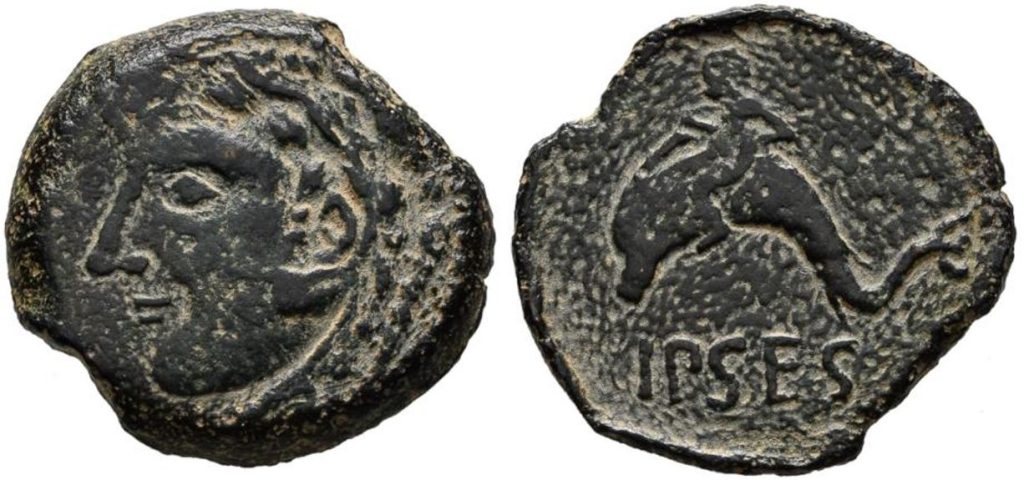
The Ipsa of the Artemidorus Papyrus and the bronze coin with Ipses are both coastal towns located by the Atlantic Ocean. In the papyrus, the mention of Ipsa is immediately followed by that of the river Anas, and by the description of the southern coast of Lusitania.
Prehistoric Lusitania in South Western Europe
There is evidence of primitive human habitation in this Celt region. The Aroeira Cave in Torres Novas, Portugal, with evidence of Neanderthal occupancy dating back 400,000 years, is one of very few Middle Pleistocene cave sites to provide a fossil cranium in association with Acheulean bifaces and the by-products of fire usage.

Large game constituted the basis of subsistence, with equids and cervids being preferentially targeted. Woodland and open landscapes formed the ecosystems supporting the populations of the mammals that were preyed upon by the inhabitants of the site.

Most of the animal carcasses were carried to, and fully butchered at the site, which was used as a residential base camp. The features of the Aroeira Cave faunal assemblage foreshadow the subsistence strategies developed by the hunter-gatherers of the Middle and the Upper Paleolithic and testify to their very ancient roots.

Footprints along Portugal’s coastal environment are considered the first two Neandertal track sites found in the southwestern Europe. Scientists used optically stimulated luminescence to date prints found on the coastal cliffs of Monte Clérigo beach, along with a single print left 82,000 years ago, roughly four miles away at Telheiro beach.

Scientists have found five Neanderthal trackways at Monte Clérigo beach that contain 26 total prints. They were able to determine that three of the tracks were left by an adult male—likely between 5-foot-6 and 5-foot-8 in height—twice from ascending the cliff dune and once descending. The other two tracks were left by children, one likely between the ages of 7 and 9, and the other from a toddler, probably younger than 2 years old.
Tracks of three individuals demonstrate how Neanderthals navigated dune landscapes and it also gives more credence to the belief that coastal environments were used by Pleistocene humans and that they were important areas in shaping hominin cognitive and social development.

The footprints, a combined result of foot anatomy, gait dynamics, and substrate properties, help tell the story of the family, which was likely camping nearby the dunes. The study of these Neanderthal footprints provides unique insights that complement other archaeological evidence, such as bones or tools. Unlike artifacts that may have been moved or discarded elsewhere, these footprints are preserved in sediments or sedimentary rocks as direct records of Neanderthal activity at specific moments in time. They provide clear evidence of Neanderthal physical presence and behavior in specific locations of South Western Europe where the Celts originate from.
Paleolithic Lusitania of South Western Europe
The Paleolithic was characterized by climate oscillations between ice ages and small interglacials. Archaeological sites containing Paleolithic remains are scattered throughout the region and constitutes the most abundant and earliest evidence of humankind in Europe, with a rich array of fossils, artifacts, and art dating back nearly one million years.
Remains of thirteen individuals buried in the Sado Valley Mesolithic shell middens of Poças de S. Bento and Arapouco in Southern Portugal, may have been mummified prior to burial, a practice possibly linked to their curation and transport, highlighting the significance of both the body and the burial place in Mesolithic south-western Portugal. Archaeologists now believe that these 8,000-year-old human skeletons may be the world’s oldest mummies. If European mummification practices do indeed date back thousands of years prior than previously known, it could enhance our understanding of Mesolithic belief systems, particularly as they relate to death and burial.
The study, published in the European Journal of Archaeology by a team from Uppsala University and Linnaeus University in Sweden and the University of Lisbon in Portugal, suggests that people in the Sado Valley were engaging in desiccation through mummification.
Paleolithic cave and rock art has survived in Lusitania until the present day. Altamira Cave is the most well-known example of the former. Escoural Cave in Portugal contains cave paintings as well as earlier remains from Neanderthals.

Most of the representations are of animals such as bison, horse, deer, bull, reindeer, goat, bear, mammoth, moose and are painted in ochre and black colors. Abstract drawings also appear in some sites.
Côa Valley, in Portugal, and Siega Verde, in Spain, formed around tributaries of the Douro river, contain the best preserved rock art. They contain petroglyphs, dating to 22 000 years ago, that document continuous human occupation from the end of the Paleolithic Age. The sites together contain thousands of animal figures carved over several millennia.
Ice Age Lusitania in South Western Europe
The last Ice age, which started about 110,000 years ago and ended about 12,000 years ago, didn’t reach beyond the Pyrenees Mountains. The region of Lusitania never froze, nor was there any permafrost like there was in Northern and Central Europe. This allowed for the continuous habitation and cultural development of the local human population.

Neolithic Lusitania in South Western Europe
This Neolithic Period is characterised by the construction of megalithic structures, such as dolmens, passage tombs and menhirs, reflecting advancements in social organisation. Lusitania has the most ancient and highest concentration of megalithic structures in Europe. The Neolithic Period in this Celt region of Lusitania laid the foundation for future societal developments, influencing the region’s cultural and historical trajectory.

The megalithic complex of Almendres, is the largest existing group of structured menhirs in the peninsula and one of the largest in Europe. This archaeological site consists of several megalithic structures that belong to the so-called – megalithic universe of Evora, with clear parallels to other megalithic complexes in the region, such as the Portela Mogos and the Vale Maria do Meio complexes.
The excavation of the site unearthed a series of both megalithic and neolithic construction phases; Almendres I 6000 BC (Early Neolithic), Almendres II 5000 BC (Middle Neolithic), and Almendres III 4000 BC (Late Neolithic). It is believed that the monuments either had a religious ceremonial purpose or functioned as a primitive astronomical observatory.


Bell Beaker Culture of Lusitania
The Bell Beaker culture is an archaeological culture named after the inverted-bell beaker drinking vessel used at the beginning of the European Bronze Age, arising as early as 2800 BC. The culture was widely dispersed from Lusitania throughout Western Europe, being present in many regions stretching eastward to the Danubian plains and into northern Europe. It was also present in the islands of Sardinia and Sicily and some coastal areas in north-western Africa.

From about 2400 BC the Beaker folk culture expanded eastwards, In parts of Central and Eastern Europe, as far east as Poland. This period marks a period of cultural contact with the Atlantic and Western Europe following a prolonged period of relative isolation during the Neolithic.
The origin of the Bell Beaker artefacts has been traced to the early 3rd millennium BC, with early examples of the maritime Bell Beaker design having been found at the Tagus estuary in Lusitania – modern Portugal, radiocarbon dated to c. 28th century BC. The inspiration for the Maritime Bell Beaker is argued to have been the small and earlier Copoz beakers that have impressed decoration and which are found widely around the Tagus estuary in Portugal.

The initial moves from the Tagus estuary were maritime. A southern move led to the Mediterranean where ‘enclaves’ were established in south-western Spain and southern France around the Golfe du Lion and into the Po Valley in Italy, probably via ancient western Alpine trade routes used to distribute jadeite axes. A northern move incorporated the southern coast of Armorica. The enclave established in southern Brittany was linked closely to the riverine and landward route, via the Loire, and across the Gâtinais Valley to the Seine Valley, and thence to the lower Rhine. This was a long-established route reflected in early stone axe distributions, and via this network, Maritime Bell Beakers first reached the Lower Rhine in c. 2600 BC.

In its mature phase, the Bell Beaker culture of Lusitania is understood as not only a collection of characteristic artefact types, but a complex cultural phenomenon involving metalwork in copper, arsenical bronze and gold, long-distance exchange networks, archery, specific types of ornamentation, and shared ideological, cultural and religious ideas.
Celts and the Atlantic Bronze Age
The Celts rose to prominence during the Atlantic Bronze Age, which started approximately in 1300 BC. This period was marked by significant cultural and economic exchanges among communities along the Atlantic coast of Europe.

Celtic Hill Forts – Castro Culture
The historical record tells us the Celts lived in both large cities and smaller remote villages. A characteristic of a Celt rural settlement site was its location on hill-tops, surrounded by one, two or even three stone defensive walls, with evidence of rectangular stone houses or associated compounds of circular stone houses.
“Along with the happy lot of their country, the qualities of both gentleness and civility have come to the Turditanians; and to the Celtic peoples, too, on account of their being neighbours to the Turdetanians, as Polybius has said, or else on account of their kinship; but less so the Celtic peoples, because for the most part they live in mere villages. “Strabo, Geographia, book 3, chapter 2.15

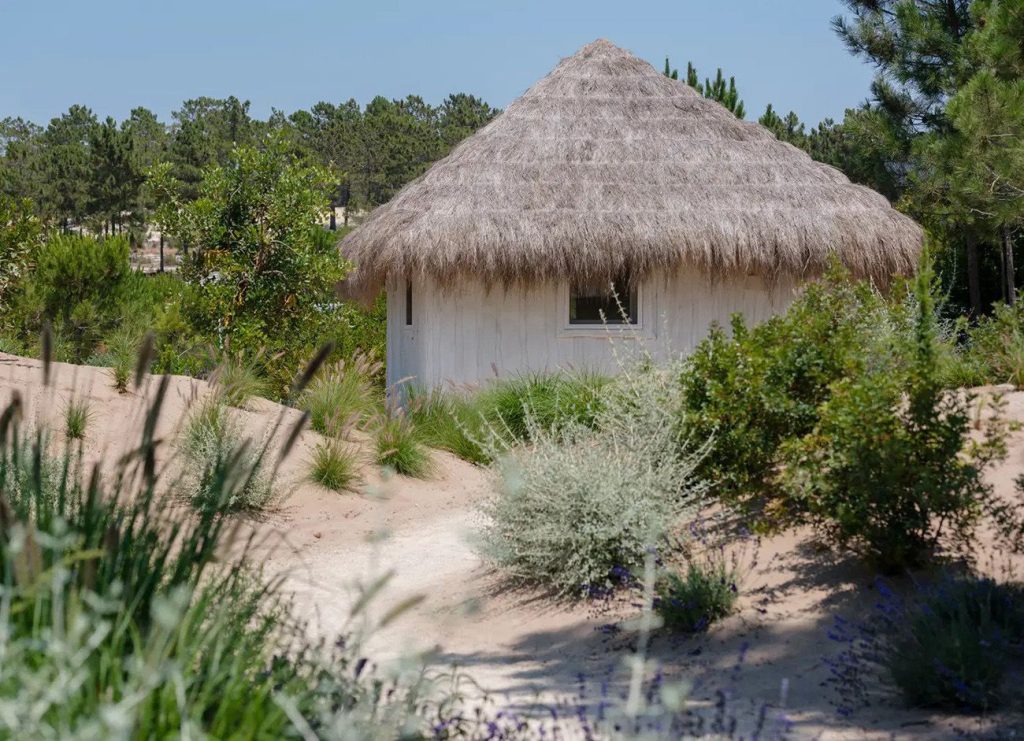
We know from the Roman architect and engineer Vitruvius c. 80–70 BC in his multi-volume work titled De Architectura, the only treatise on architecture to survive from antiquity, how the Celts in Southern Lusitania built the roofs their houses and how the Celts constructed bricks.
“we can see for ourselves from the buildings that are to this day constructed of like materials by foreign tribes: for instance, in Gaul, Spain, Lusitania, and Aquitaine, roofed with oak shingles or thatched.” Vitruvius, Ten Books on Architecture, book 2, chapter 1, section 4
“In the states of Maxilua and Callet, in Further Spain, there are bricks which, when finished and dried, will float on being thrown into water. The reason why they can float seems to be that the clay of which they are made is like pumice-stone. So, it is light, and also it does not, after being hardened by exposure to the air, take up or absorb liquid. So, these bricks, being of this light and porous quality, and admitting no moisture into their texture, must by the laws of nature float in water, like pumice, no matter what their weight may be. They have therefore great advantages; for they are not heavy to use in building and, once made, they are not spoiled by bad weather.” Vitruvius, Ten Books on Architecture, book 2, chapter 3, section 4
Celtic Horse Tradition
The horse is one of the animals most strongly associated and intertwined with Celtic culture. We have evidence that the horses were domesticated in Lusitania, with wild horses continually being bred into the domestic breeds. Since the beginning of time, this region has been isolated from the rest of the world by the mountains and the Atlantic Ocean surrounding it. This allowed the horses from this region to develop and evolve without outside influences. Because the last Ice Age did not reach Lusitania – modern day Portugal, the horse and mounted horse culture developed there much sooner than the rest of the world.

Horses have been present in the Celtic region of Lusitania for over 25,000 years. Drawings of horses which look remarkably like the modern Lusitano breed are found on the Escoural Caves of Alentejo in Portugal and date back to 17000 BC. This makes the Lusitano horse one of the oldest saddled horses in the world. This early partnership between the Lusitano horse and human is believed to be the inspiration for the Greek legend of Centaurs.

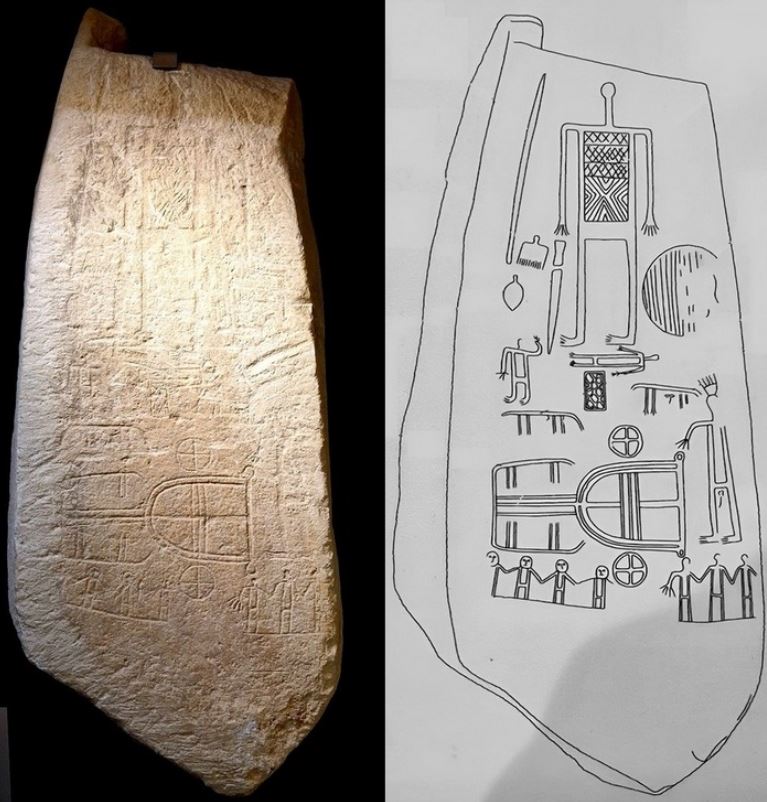
The Celts in Lusitania used two wheeled chariots drawn by two horses tied to one central draught pole. Carved representations on stelae of humans, horses and chariots have been found in Cordoba (Ategua stelae) and in Solana de Cabanas. Remains of chariots dating to the 7th century BC have been found at La Joya iron age cemetery in Huelva and at grave 89 Alcacer do Sal near Lisbon.
When describing Celtic people in central Europe, Diodorus states:
“In their journeyings and when they go into battle the Gauls use chariots drawn by two horses, which carry the charioteer and the warrior; and when they encounter cavalry in the fighting they first hurl their Javelins at the enemy and then step down from their chariots and join battle with their swords.”Diodorus Siculus, Library of History, book 5, Chapter 29
Several rock art depictions of chariots have been found in the region of ancient Lusitania dated between the first and second iron age.

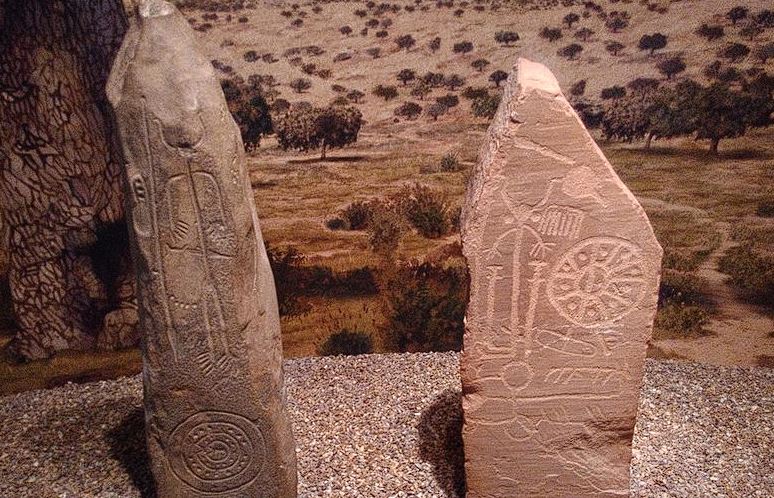
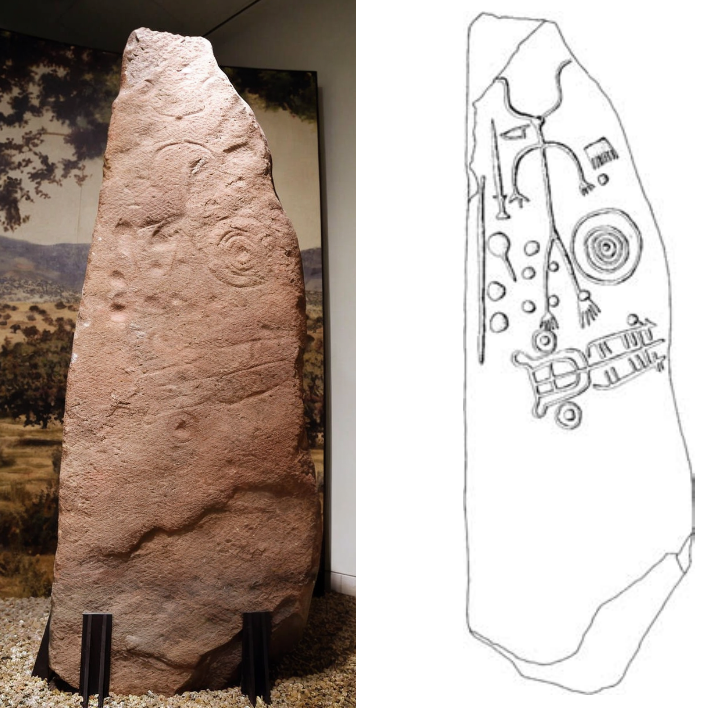
Bronze votive statuettes of a chariot and horseman dated to the 5th century BC have been found in Merida and Almorchón, Badajoz – ancient Lusitania.

Strabo records the Celts from Lusitania held different types of contests including ones which involved cavalry.
“They also hold contests, for light-armed and heavy-armed soldiers and cavalry, in boxing, in running, in skirmishing, and in fighting by squads.” Strabo, Geographia, book 3, chapter 3.7
An interesting story of a wealthy Celt on his chariot is as follows:
“And Posidonius continuing, and relating the riches of Lyernius … says that he, aiming at becoming a leader of the populace, used to drive in a chariot over the plains, and scatter gold and silver among the myriads of Celts who followed him”Athenaeus of Naucratis, Deipnosophistae, book 4, chapter 37
The Celts worshipped the female goddess Epane who was concerned with the protection of horses. Celtic horsemanship was much admired in the ancient world. Diocles was a famous Celtic charioteer from the Lusitanian region, known for his remarkable career in chariot racing during antiquity. He is often regarded as one of the highest-paid athletes of his time, with a record of 1,064 wins in individual races.
This Celtic tradition of horsemanship continues to be a significant aspect of Lusitanian and modern-day Portuguese culture, deeply rooted in history. This tradition reflects the region’s connection to its Celtic past and the influence of the Lusitano horse breed.

Strabo states:
“The Celtiberian horses are like those of Parthia, he says, for not only are they faster but they are also smoother runners than the other horses. ” Strabo, Geographia, book 3, chapter 4.15
Regarding the horses of Lusitania, Pliny states:
“It is well known that in Lusitania, in the vicinity of the town of Olisipo and the river Tagus, the mares, by turning their faces towards the west wind as it blows, become impregnated by its breezes, and that the foals which are conceived in this way are remarkable for their extreme fleetness.”Pliny the Elder, Natural History Book 8, Chapter 67
“Galicia and Asturia…they produce a species of horse known to us as thieldones, and when smaller, asturcones; they have a peculiar and not common pace of their own, which is very easy, and arises from the two legs of the same side being moved together; (clearly alludes to the canter movement) it is by studying the nature of this step that our horses have been taught the movement which we call ambling. “Pliny the Elder, Natural History Book 8, Chapter 67
Horsemanship was so revered by the Celts they even minted their coins depicting horse warriors. Such examples of Celtic coins were found in the Lusitanian Vettone Castro de Villas Veilhas de Tamusia date to the 4th Century BC.
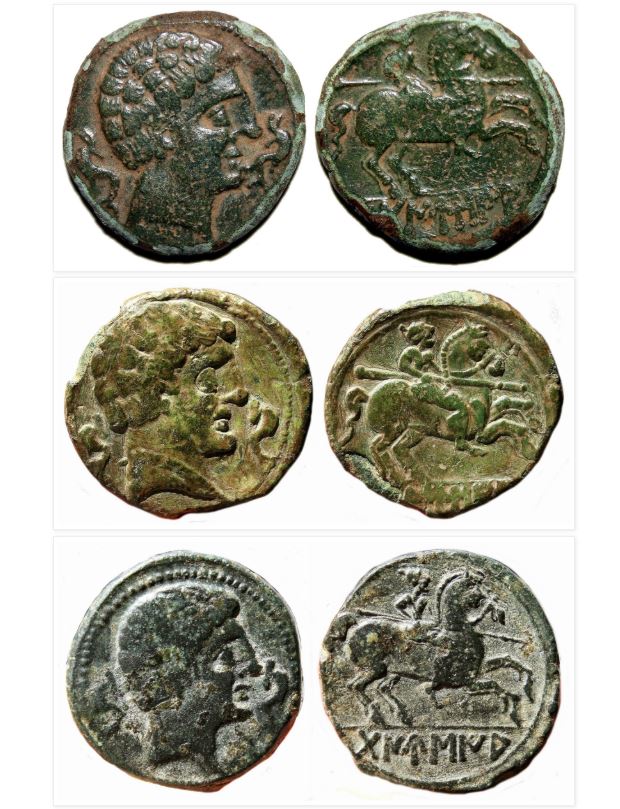
The horsemanship of the Celts from Extremadura in Lusitania were to later make a major impact during the conquest of the Inca and the Aztec empires in the early 16th century. The cavalry provided a significant military advantage due to the psychological impact and mobility it offered the conquistadors.
Manca, the leader of the Incas is quoted as saying:
“My kingdom for a horse”
Starting in the 16th century, Celts from Portugal and Spain upon their arrival to the Americas introduced their horses and traded them with the Native Americans and it quickly transformed their hunting efficiency, especially that of the Native Americans from the Great Plains.
The Portuguese and Spanish horses became integral to various aspects of Native American culture, influencing social structures and community dynamics. They were featured in art, stories, and ceremonies, highlighting their importance beyond mere utility. They were often seen as sacred beings, embodying strength and healing. For instance, the Lakota referred to horses as “Sun’ka Wakan,” meaning “Holy Dog,” reflecting their revered status.
Celtic Tradition of Ranching
Ranching originated in Portugal and Spain, where it began as a practice of raising livestock on large plots of land. The term “ranch” itself comes from the Portuguese Celtic word “rancho,” and this method of animal husbandry was later brought to the Americas.
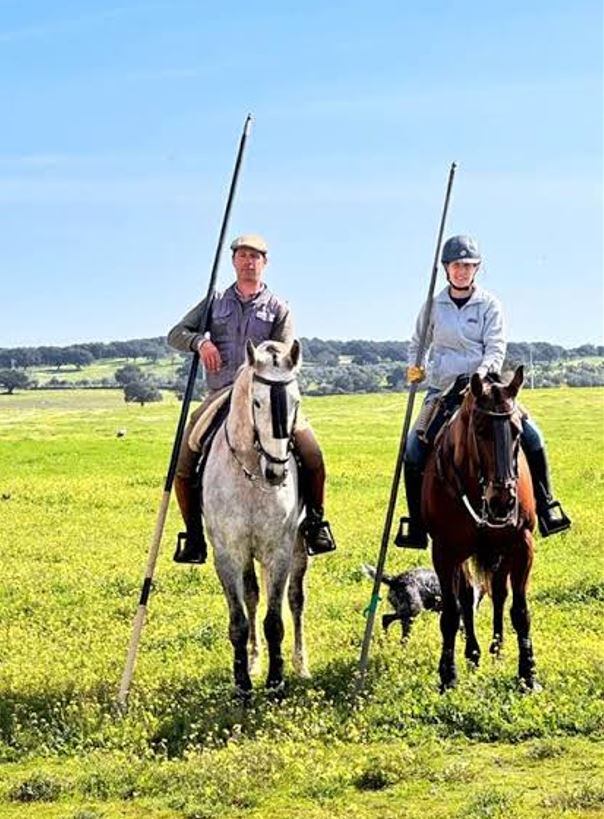
Since the ancient times the Celts of Alentejo, Portugal were afforded with vast plains where the horse played a vital role in ranching by assisting in herding cattle and managing the land.
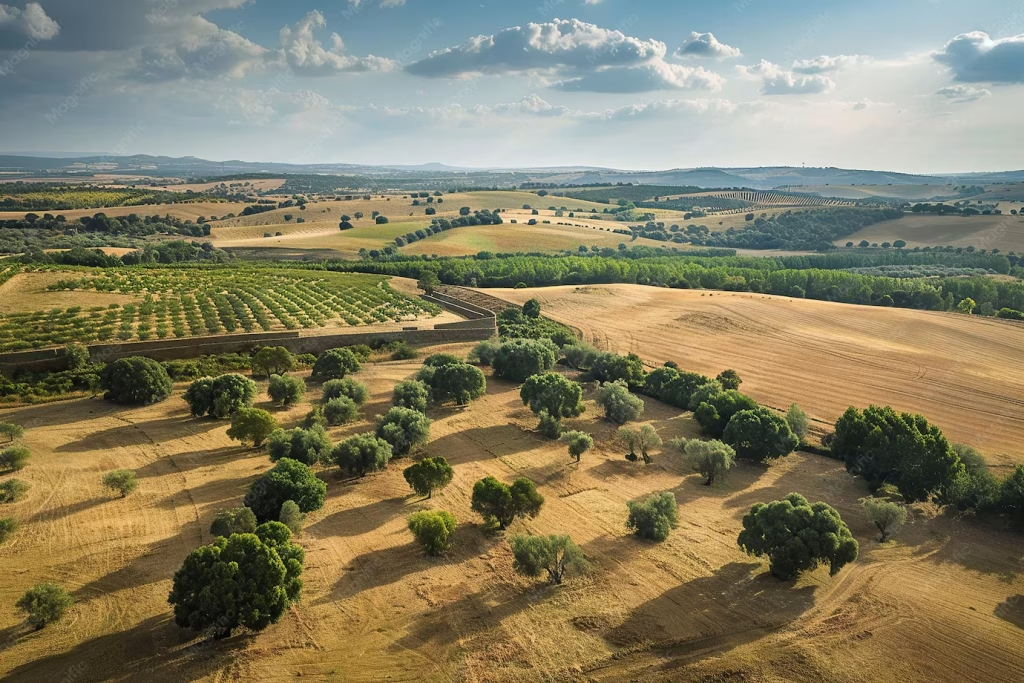
Related to ranching, the ancient Celts practiced bullfighting, which evolved from rituals involving bulls. The practice has roots that trace back to prehistoric times and developed significantly over the centuries. Bullfighting has its origins in ancient Lusitanian Celtic culture, where local tribes practiced rituals centered around bulls as offerings to deities or displays of strength, reflecting their significance in local customs and spirituality. Over the centuries, bullfighting became a symbol of Lusitanian identity, reflecting bravery and skill and these early ceremonies laid the cultural foundation that influenced later bullfighting practices, evolving into the structured spectacle known today.
The Bulls of Guisando are examples of a type of ancient sculpture called Verracos of which hundreds are known. They are associated with the territory of the Celtic Lusitanian peoples known as the Vettones. The Bulls have been dated to the 2nd century BCE.
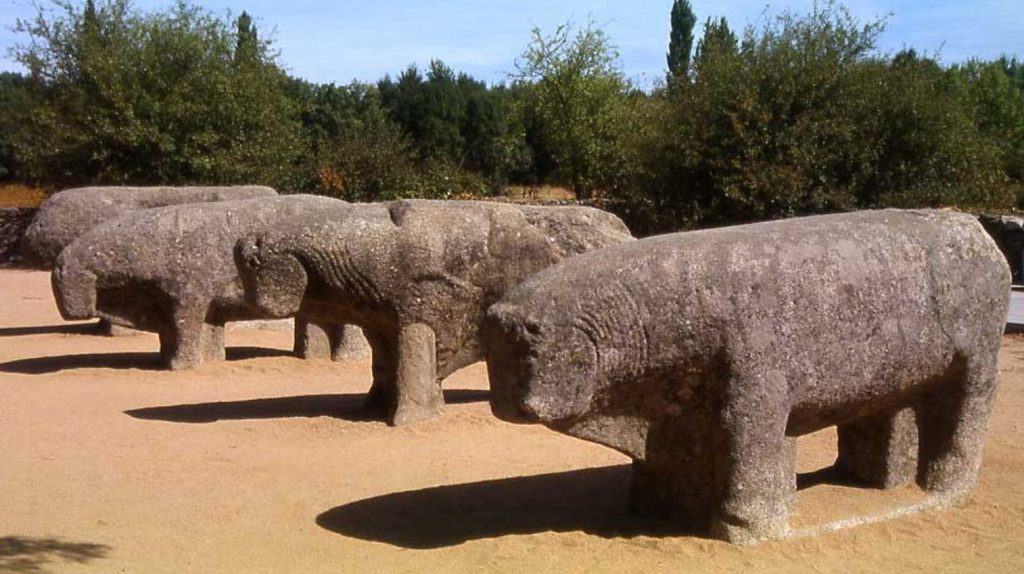
In ancient Lusitania, bulls were significant in religious practices, often associated with sacrifices to deities like Reve, the sky god linked to thunder and judgment. The worship of bulls was a common aspect of Lusitanian mythology, reflecting their importance in both agriculture and ritual.
The act of bull sacrifice symbolized not only religious devotion but also agricultural prosperity, as bulls were vital for farming and livestock. Bulls were essential for farming activities of the Celts, contributing to the agricultural richness of the region. Their strength was utilized in plowing and other farming tasks. The presence of bulls in agriculture supported the economy of ancient Lusitania, which was known for its agricultural output. Bulls were thus central to both the spiritual and practical life of the Celtic Lusitanians, reflecting their dual role in religion and agriculture.
In Portugal there’s a practice of bullfighting which involves eight men challenging the bull with their bare hands. They form a line facing the bull and the front man tempts the bull on by playing with it and taking steps forward if necessary to get it to charge. Once the bull runs forward the first man times his hold of the bull’s head. Once on the bull’s head and holding onto it, usually around its neck, the remaining men jump upon the bull piling upon themselves and grabbing the bull. The objective is to subdue the bull, to stop it. Bullfighting in Portugal does not allow for the bull to be killed, the bull is then released and herded out of the arena.
Forcados Bullfighting Santarem, Portugal
Various forms of bullfighting continue to be practiced in several Celtic nations such as France, Spain and Portugal.
Celtic War Dogs
The war dogs of the Celts were used by tribes like the Celtiberians and were known to be highly effective against cavalry, causing terror, disorder and highly capable of tracking. They were renowned for being man-stoppers and were highly feared.
“king of the Allobroges, met him, arrayed magnificently and followed by attend ants also adorned, and by dogs; for the barbarians of this region use dogs also as bodyguards.”Appian, Roman Histories, book 4 – The Gallic History, chapter 12
“the Celts, however, use both these and the native dogs for the purposes of war too”Strabo, Geographia, book 4, chapter 5.2
A description by the Incas in the 16th Century of the Celtic war dogs used by the Conquistadors is as follows:
“There dogs are enormous with flat ears and long dangling tongues, the colour of their eyes is a burning yellow, their eyes flash fire and shoot off sparks, their bellies are hollow, their flanks long and narrow, they are tireless and very powerful, they bound here and there panting with their tongues hanging out and they are spotted like an ocelot”16th Century Florentine Codex
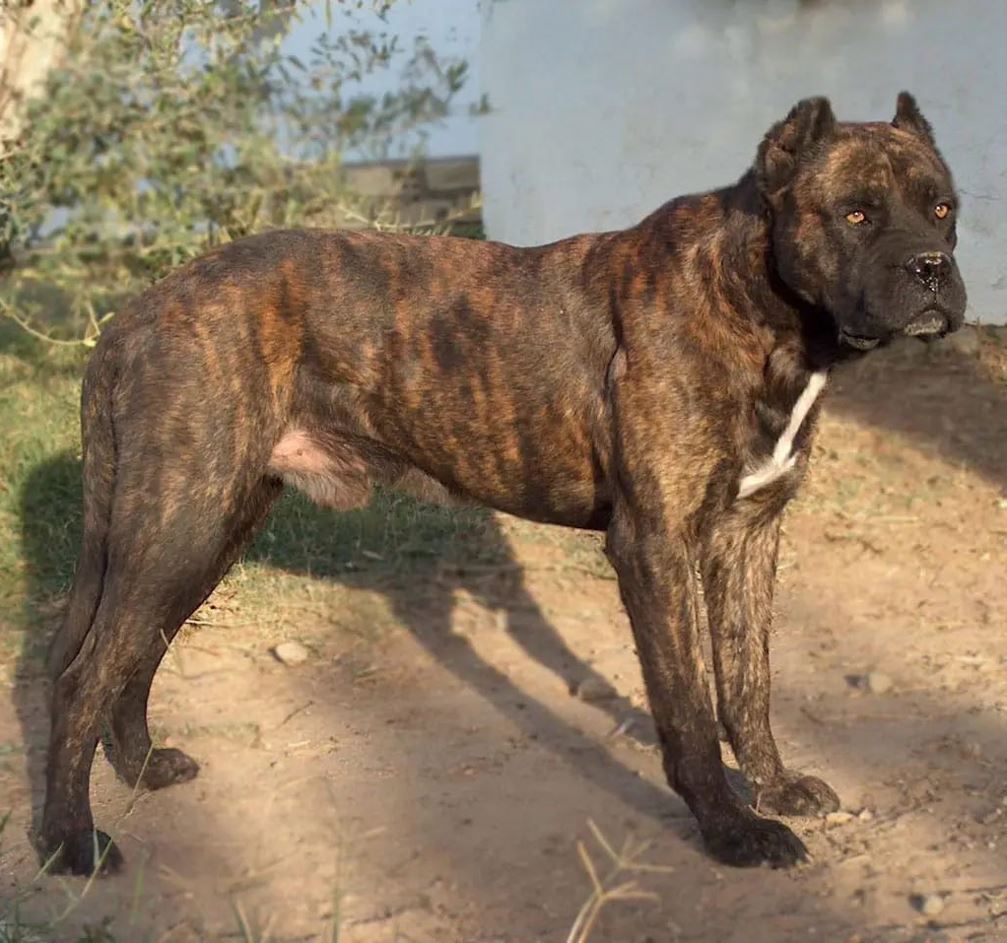
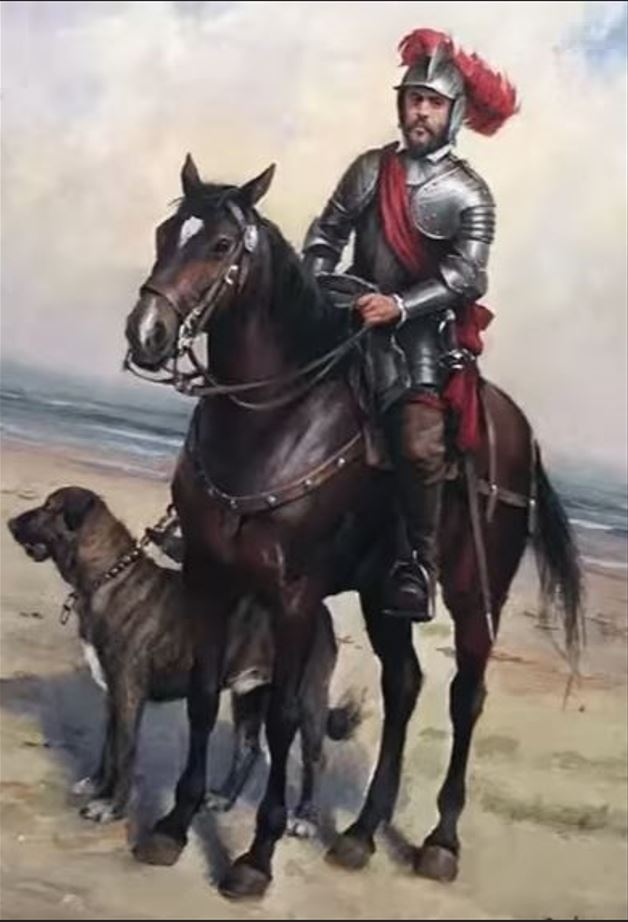
The Portuguese Cristobal de Colon later reflects in his journal, he writes when fighting the native Americans, one dog is worth ten soldiers. On his second trip to the New World he took 20 war dogs. Many other famous Conquistadors such as Ponce de Leon, Hernan Cortes, Hernando de Soto and Francisco Pizarrro all used war dogs during their conquests. The most famous and feared of all the war dogs was Berserilo.
Celtic Migrations in Europe
The Celts at varying stages migrated eastwards and northwards populating much of the Western European continent reaching up to the Rhine river border of the Germanic people to the north.
Arrian writes of a meeting between the Celts and Alexander the Great’near the Danube River in 335 BC.
“On the third day after the battle, Alexander reached the river Ister [Danube], which is the largest of all the rivers in Europe, traverses a very great tract of country, and separates very warlike nations. Most of these belong to the Celtic race, in whose territory the sources of the river take their rise.”Arrian, Anabasis of Alexander, book 1, chapter 3
“There ambassadors came to him from Syrmus, king of the Triballians, and from the other independent nations dwelling near the Ister. Some even arrived from the Celts who dwelt near the Ionian gulf. These people are of great stature, and of a haughty disposition. All the envoys said that they had come to seek Alexander’s friendship. To all of them he gave pledges of amity, and received pledges from them in return. He then asked the Celts what thing in the world caused them special alarm, expecting that his own great fame had reached the Celts and had penetrated still further, and that they would say that they feared him most of all things. But the answer of the Celts turned out quite contrary to his expectation; for, as they dwelt so far away from Alexander, inhabiting districts difficult of access, and as they saw he was about to set out in another direction, they said they were afraid that the sky would some time or other fall down upon them. These men also he sent back, calling them friends, and ranking them as allies, making the remark that the Celts were braggarts.”Arrian, Anabasis of Alexander, book 1, chapter 4
We have further evidence of the movement of Celt tribes into southeastern Europe around the 4th century BC. The Celts entered into the lands of Etruria, Illyria, Thessaly, Macedonia and Greece after the death of Alexander the Great. Some Celt groups continued to migrate further eastwards, eventually settling in areas like Anatolia, where they became known as the Galatians.
When describing the Celts movement into southeastern Europe Pausanias states:
“Now these Galati inhabit the remotest parts of Europe, near a mighty sea, not navigable where they live: it has tides and breakers and sea monsters quite unlike those in any other sea: and through their territory flows the river Eridanus, by whose banks people think the daughters of the sun lament the fate of their brother Phaethon. And it is only of late that the name Galati has prevailed among them: for originally they were called Celts both by themselves and by all other nations. And an army gathered together by them marched towards the Ionian Sea, and dispossessed all the nations of Illyria and all that dwelt between them and the Macedonians, and even the Macedonians themselves, and overran Thessaly.”Pausanias, Description of Greece, book 1, chapter 4
As with all other classical historians, Pausanias also describes the Celts as originating in South Western Europe beyond the Pillars of Hercules near a mighty sea – Atlantic Ocean. The Pillars of Hercules were seen as the boundary of the known world to the Greeks in ancient times, and the river Eridanos was thought to lie beyond this boundary, symbolizing the edge of the known universe.
From their genesis in Lusitania – modern Portugal, the Celts and Celtic civilisation over thousands of years slowly expanded into northern Europe up to the border with the Germanic people and as far eastwards into the region of Galatia in Anatolia – modern central Turkey.
The Migration of the Celts from their Origins in Lusitania
Ephorus of Kyme (c.405 – c.330 BC), author of the first universal history, whose remaining fragments were used by Strabo, produced the earliest extant account of the land of the Celts. Ephorus was cited by Strabo as stating that Celtica was so large that is extended from Gaul to also encompass Iberia down to Gades (Cadiz) and the Pillars of Hercules. Ephorus also states in ancient times, Iberia was known as Celtica.Strabo, Geographia, book 4, chapter 4.6
Celts and the Germans
The Celts and Germans are distinct cultures within the European family, with different languages, religions, and social structures. Though both native to Europe, they often clashed on the borders of the Rhine river and the Ister [Danube] rivers.
Herodotus states:
“For the Ister [Danube] flows through all of Europe rising amongst the Celts“.
The Danube river originates in modern West Germany in the Black forest where two small rivers, the Breg and Brigach, meet.
Herodotus then wrote:
“For the Ister [Danube], beginning in the land of the Celts and the city of Pyrene flows through the middle of Europe. The Celts live beyond the Pillars of Hercules…”
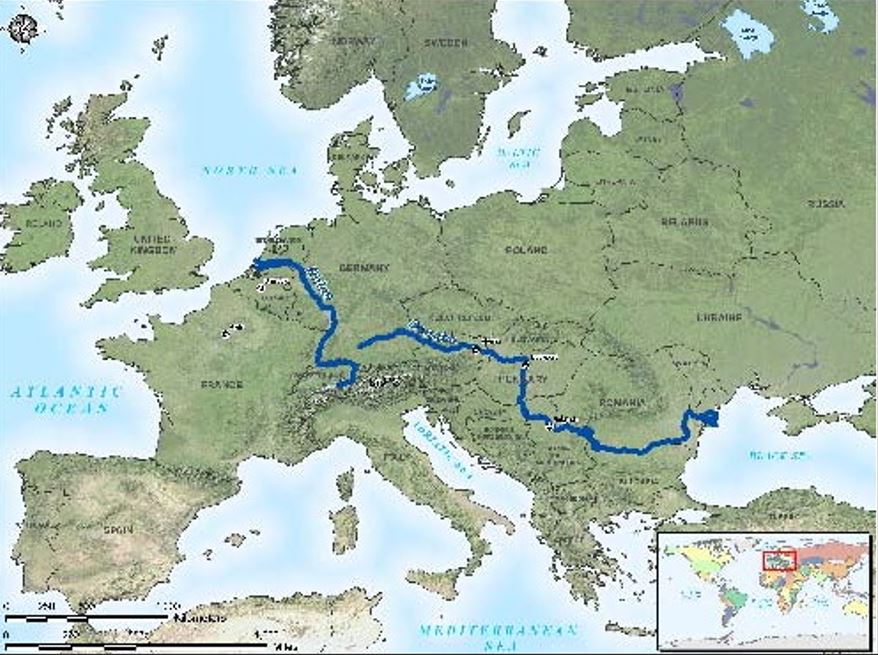
From their origins beyond the Pillars of Hercules, in Lusitania, the Celts were over the centuries found south of both rivers while the Germans dwelt to the north of these rivers.
Celts and the Etruscans
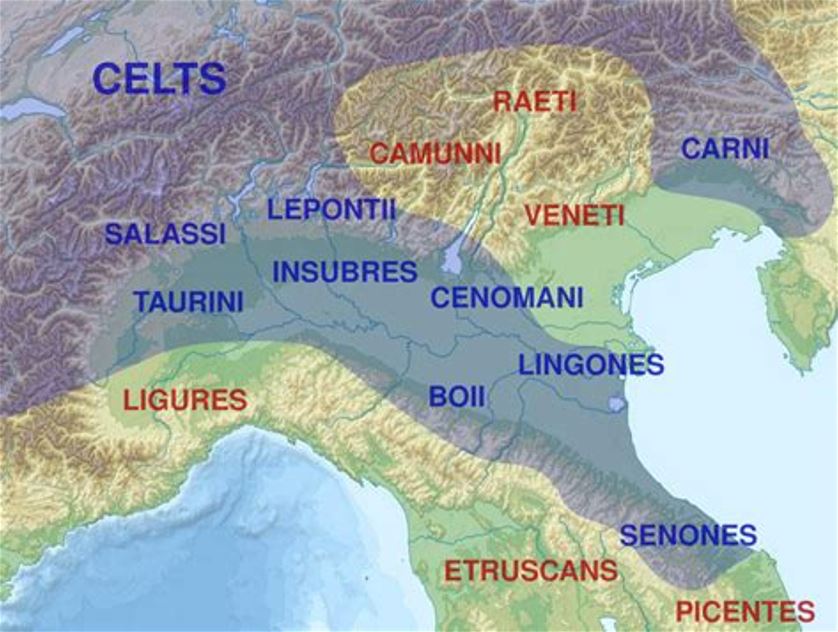
There seems to have been a kinship between the Etruscans and the Celts. There are many Etruscan words that seem to trace to a Celtic source and experts in the Etruscan language acknowledge that three fossil words of the Etruscan language – kapra, gapus and laena are Celtic.
Dionysius of Halicamassus (circa B.C. 50), in his “Roman Archaeology,” asserts that the Etruscans were the indigenous inhabitants of their country. The traditional narrative is the Estruscan Tarquini Dynasty were the original kings of Rome, before they were overthrown in and around 509 BC.
We know the Etruscans and Celts were neighbours and that the Celts frequently allied with the Etruscans during their conflicts with the Romans. This partnership was especially significant during the 3rd century BC, a period marked by Roman expansion. The Celts and Etruscans shared cultural and military ties, which facilitated their cooperation in battles against a common enemy. In 225 BC, during the Battle of Clusium and the Battle of Telamon, the Celts allied with Etruscans against Roman forces.
Celts and the Illyrians
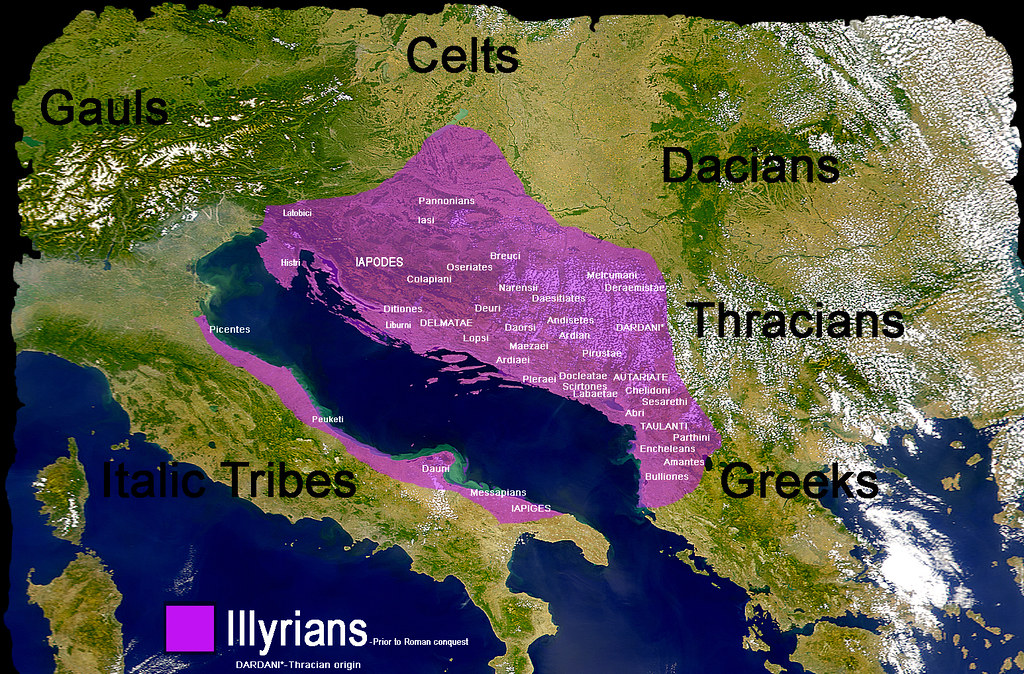
The Illyrians are a native European people. Celts and Illyrians interacted as early as the Iron Age, a period when both cultures were prominent in Central Europe. This interaction is supported by archaeological findings that indicate exchanges and influences between the two groups. Artifacts and settlement patterns suggest that the Celts and Illyrians shared territories and possibly engaged in trade. There is evidence of cultural influences, including similarities in material culture and possibly language.
Archaeological evidence suggests that Celtic and Illyrian interactions occurred through trade and cultural exchange, particularly in regions like the Balkans where artifacts such as pottery and metalwork show similarities. Additionally, the presence of Celtic coins and weapons in Illyrian territories indicates a level of contact and influence between these two groups.
We know of a wave of Celtic interaction with the Illyrians in an around the 4th Century BC
“Now these Galati inhabit the remotest parts of Europe, near a mighty sea, not navigable where they live: it has tides and breakers and sea monsters quite unlike those in any other sea: and through their territory flows the river Eridanus, by whose banks people think the daughters of the sun lament the fate of their brother Phaethon. And it is only of late that the name Galati has prevailed among them: for originally they were called Celts both by themselves and by all other nations. And an army gathered together by them marched towards the Ionian Sea, and dispossessed all the nations of Illyria and all that dwelt between them and the Macedonians, and even the Macedonians themselves, and overran Thessaly.”Pausanias, Description of Greece, book 1, chapter 4
The first Balkan tribe to be defeated by the Celts was the Illyrian Autariatae, who, during the 4th century BC, had enjoyed a hegemony over much of the central Balkans, centered on the Morova Valley. In 310 BC, the Celtic general Molistomos attacked deep into Illyrian territory, trying to subdue the Dardanians, Paeonians and Triballi. However Molistomos was defeated by the Dardanians.
Celts and the Macedonians
The Celts and Macedonians had significant interactions during the 3rd century BC, particularly during the Celtic invasions of the Balkans. This period was marked by political instability in Macedonia following the death of Alexander the Great. Prior this we know from Arrian, the Celts had a friendly meeting with Alexander the Great near the Danube River in 335 BC while Alexander was engaged in wars against the Thracians on Macedonia’s northern border.
There was a second meeting between the Celts and Alexander in 323 BC in Babylon.
“When Alexander entered Babylon embassies met him from the Libyans, extolling him and crowning him w4th garlands on account of his success in winning the empire of Asia; and from Italy, the Brettii, the Leucani and the Tyrreni sent an embassy for a similar purpose. It is also stated that the Carthaginians sent an embassy at the same time, and that envoys came from the Ethiopians, the European Scythians, the Celts, and the Iberians, soliciting his friendship.”Arrian, Anabasis, book vii, chapter 15.4
In 279 BC a coalition of Celtic tribes, led by chieftains such as Brennus and Bolgios, invaded Macedonia and Greece. The Celts inflicted heavy losses on the Macedonian forces. Notably, they captured King Ptolemy Keraunos during these encounters.
Celts and the Thracians
In 298 BC, the Celts attempted a penetrating attack into Thrace, where they suffered a heavy defeat near Haemus Mons at the hands of Cassander. However, another body of Celts led by the general Cambaules marched on Thrace, capturing large areas. The Celtic tribe of the Serdi lived in Thrace and founded the city of Serdica, present day Sofia, Bulgaria.
Celts and the Dacians
The Celts and Dacians (Getae), modern Romanians, interacted significantly, especially during the Celtic migrations into Dacia around the 4th century BC. This period marked a time of cultural exchange and coexistence between the two groups. Archaeological evidence indicates that Celtic culture was present in Transylvania from around the 4th century BCE, with significant sites like the La Tène necropolis at Apahida revealing Celtic artifacts and burial practices
More Celts arrived during the 3rd century BC, and in the 1st century BC the people of Boii tried to conquer some of the Dacian territory on the eastern side of the Teiss river. The Dacians drove the Boii south across the Danube and out of their territory, at which point the Boii abandoned any plans for further territory.
Celts and the Greeks
The Celts were somewhat known to the Greeks since antiquity. The story of Jason and the Arganouts mentions these Greeks travelling through western lands where the Celts lived. The voyage of Jason and the Argonauts is believed to have occurred around 1300 BC, before the Trojan War.
“Thus Argo cried through the darkness; and the sons of Tyndareus uprose, and lifted their hands to the immortals praying for each boon: but dejection held the rest of the Minyan heroes. And far on sped Argo under sail, and entered deep into the stream of Eridanus; where once, smitten on the breast by the blazing bolt, Phaethon half-consumed fell from the chariot of Helios into the opening of that deep lake; and even now it belcheth up heavy steam clouds from the smouldering wound. And no bird spreading its light wings can cross that water; but in mid-course it plunges into the flame, fluttering. And all around the maidens, the daughters of Helios, enclosed in tall poplars, wretchedly wail a piteous plaint; and from their eyes they shed on the ground bright drops of amber. These are dried by the sun upon the sand; but whenever the waters of the dark lake flow over the strand before the blast of the wailing wind, then they roll on in a mass into Eridanus with swelling tide. But the Celts have attached this story to them, that these are the tears of Leto’s son, Apollo, that are borne along by the eddies, the countless tears that he shed aforetime when he came to the sacred race of the Hyperboreans and left shining heaven at the chiding of his father, being in wrath concerning his son whom divine Coronis bare in bright Lacereia at the mouth of Amyrus. And such is the story told among these men.”
“Thence they entered the deep stream of Rhodanus which flows into Eridanus; and where they meet there is a roar of mingling waters. Now that river, rising from the ends of the earth, where are the portals and mansions of Night, on one side bursts forth upon the beach of Ocean, at another pours into the Ionian sea, and on the third through seven mouths sends its stream to the Sardinian sea and its limitless bay. And from Rhodanus they entered stormy lakes, which spread throughout the Celtic mainland of wondrous size; and there they would have met with an inglorious calamity; for a certain branch of the river was bearing them towards a gulf of Ocean which in ignorance they were about to enter, and never would they have returned from there in safety. But Hera leaping forth from heaven pealed her cry from the Hercynian rock; and all together were shaken with fear of her cry; for terribly crashed the mighty firmament. And backward they turned by reason of the goddess, and noted the path by which their return was ordained. And after a long while they came to the beach of the surging sea by the devising of Hera, passing unharmed through countless tribes of the Celts and Ligurians.”Apollonius of Rhodes, Argonautica, book 4
Celt and the Scythians
Classical authors speak of a temporary Gallo-Scythian or Celt-Scythian confederation of peoples. Claudius Ptolemy mentions several place and ethnic names on the lands of Scythia Magna which are undoubtedly Celtic. Celtic place and ethnic names are also mentioned by Greek authors Strabo and Plutarch. Plutarch, who used the records of Posidonius (late 2nd c BC), stating that the Celtic peoples stretched to the Moeotis littoral zone of the Azov Sea.
“to the Maeotic Lake [Azov Sea] on the east, where it bordered on Pontic Scythia, and that from that point on Gauls and Scythians were mingled. These mixed Gauls and Scythians had left their home and moved westward, not in a single march, nor even continuously, but with each recurring spring they had gone forward, fighting their way, and in the course of time had crossed the continent. Therefore, while they had many different names for different detachments, they called their whole army by the general name of Galloscythians.’’ Plutarch. The Life of Marius, chapter 11, 4-5
“The ancient Greek historians called all the nations towards the north by the common name of Scythians, and Celt-Scythians” Strabo, Geographia, book 11, chapter 6.2
Celts in Anatolia
“The Galatians, then, are to the south of the Paphlagonians. There are three peoples among them. Two of them, the Trokmians and the Tolistobogians, are named after their leaders, whereas the third, the Tektosagians, is named after the people in the Celtic region. This country was occupied by the Galatians after they had wandered around for a long time and after they had overrun the country that was subject to the Attalid and Bithynian kings, until by voluntary concession they received the present Galatia, or Gallo-Graecia, as it is called. Leonnorios is generally reputed to have been the chief leader of their expedition across to Asia.
The three peoples spoke the same language and in no way differed from each other. Each was divided into four portions which were called “tetrarchies,” each tetrarchy having its own tetrarch and also one judge and one military commander, both subject to the tetrarch, and two subordinate commanders. The Council of the twelve tetrarchs consisted of three hundred men, who assembled at “Drynemeton,” as it was called. Now the Council passed judgment upon murder cases, but the tetrarchs and the judges upon all others. Such, then, was the organization of Galatia long ago. However, in my time the power has passed to three rulers, then to two, and then to one, Deiotaros, and then to Amyntas, who succeeded him. But at the present time the Romans possess both this country and the whole of the country that became subject to Amyntas, having united them into one province.
The Trokmians possess the areas near Pontos and Cappadocia. These are the most powerful of the parts occupied by the Galatians. They have these walled garrisons: Tavium, the trading-centre of the people in that part of the country. This is where there are: the colossal statue of Zeus in bronze and his sacred precinct, a place of refuge; the Mithridation, which Pompey gave to Bogodiataros, having separated it from the kingdom of Pontus; and, third, Danala, where Pompey and Lucullus had their conference, Pompey coming there as successor of Lucullus in command of the war and Lucullus giving over to Pompey his authority and leaving the country to celebrate his triumph.
The Trokmians, then, possess these areas, but the Tektosagians possess the areas near Greater Phrygia in the neighbourhood of Pessinos and Orkaorki. To the Tectosagians belonged the fortress Ankyra, which bore the same name as the Phrygian town situated toward Lydia in the neighbourhood of Blaudos.
The Tolistobogians border on the Bithynians and Phrygia “Epictetus”, as it is called. Their fortresses are Bloukion and Peion, the former of which was the royal residence of Deiotaros and the latter the place where he kept his treasures.”Strabo, Geographia, book 12, chapter 5,1-2
Celt Maritime History
The Celts had a rich and important local boatbuilding tradition since prehistoric times. There are some written sources that mentioned the existence of boats in the Atlantic Ocean. The earliest of them comes from Avienus´ Ora Maritima written in the 6th Century BC, which relates how the people who lived along the Atlantic Lusitanian coasts, sailed the ocean in boats made of sewn skins.
Avienus states:
“Overcome all with the passion of commerce, they sail with boats made out of skins along the cloudy sea and the abyss of the Ocean dwelled by monsters”Avienus, Ora Maritima, chapter 100-107
“they foster fibres longer and heavy for the use of camps and for naval sails.
from here the way is said to the river of the single sun, and here the boundary of the people and of the Cynetes. “Avienus, Ora Maritima, chapter 220
There is presence of nautical representations and important iconographic evidence on the Lusitanian coast such as the Borna petroglyphs at Pontevedra, Galicia, the boat rock art at La Laja Alta and the boat art found in at the Dolmen of Antelas Oliveira de Frades, Portugal.

The paintings at the Dolmen of Antelas are made in two colours, red and black. The radiocarbon dates obtained from the organic elements found in the paintings give a date between 4340 – 3140 BC. It is indeed one of the oldest nautical iconographic representations found in the Iberian Peninsula.

The vessel depicted at the Dolmen de Antelas is sailing over the sea, depicted by three undulating parallel lines. It can be interpreted as a reed-bundle boat where we can appreciate three or four bundles of stems, tied among them with lashings, and represented by vertical lines in the hull. Above the hull there are three vertical lines that could correspond to a tripod mast and a perpendicular line that could be a yard, very common in reed bundle crafts. Another interpretation identified it as a plank boat coaked and sewn joints, more complex than a simple monoxylon canoe.Arturo Rey da Silva, Nautical Iconography from the Iberian Peninsula,
We also have historical written accounts of boat building and navigational abilities of the Celts:
“Gades, however, is outside the Pillars. Concerning Gades I have said only thus much, that it is about seven hundred and fifty stadia distant from Calpe, that is, it is situated near the outlet of the Baetis, but there is more to be said about it than the others. For example, here live the men who fit out the most and largest merchant-vessels, both for Our Sea and the outer sea. “Strabo, Geographia, book 3, chapter 5.3
“Now the Tagus not only has a width of about twenty stadia at its mouth, but its depth is so great that very large merchant-ships can ascend it…And further, not only is the country round about the city rich, but the voyages thither are easy—even for large ships a considerable part of the way, though only for the river-boats the rest of the way.” Strabo, Geographia, book 3, chapter 1.1
When speaking of the Turdetanians Strabo states:
“And they build their ships there out of native timber”Strabo, Geographia, book 3, chapter 2.6
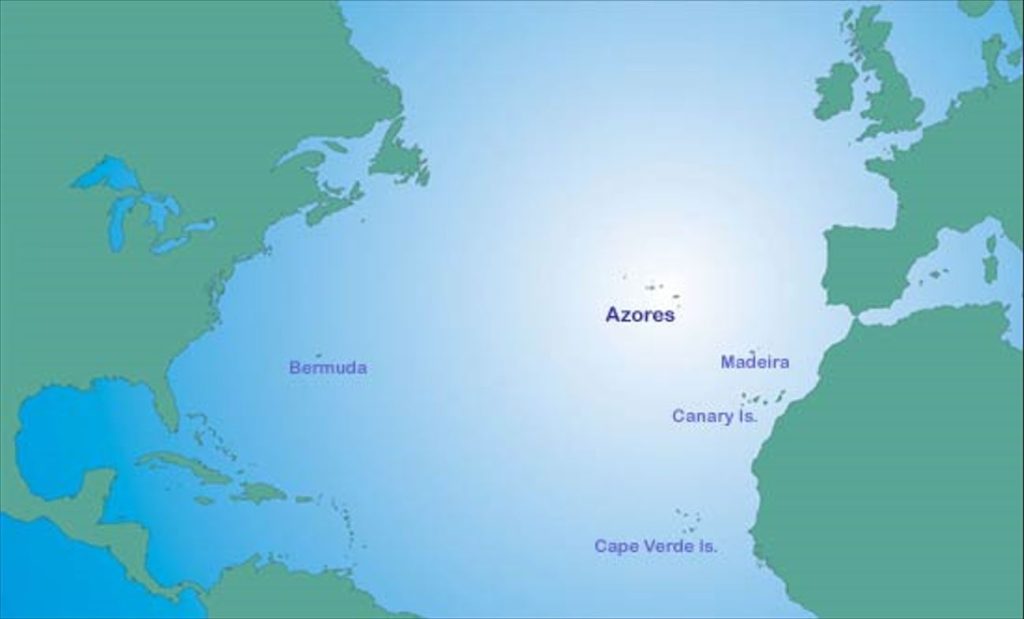
Celtic exploration of the world was furthered by the Portuguese when they began with maritime expeditions to the Macaronesian islands, including the Canary Islands, as well as Madeira, Azores and Cape Verde islands. It continued with voyages along the coast of West Africa in 1434, and culminated in the establishment of a sea route to India in 1498 by Vasco da Gama, to the Americas by Pedro Álvares Cabral, to China by Jorge Álvares, to Japan by Antonio Mota, Francisco Zeimoto, and António Peixoto and to Australia by Cristóvão de Mendonça.
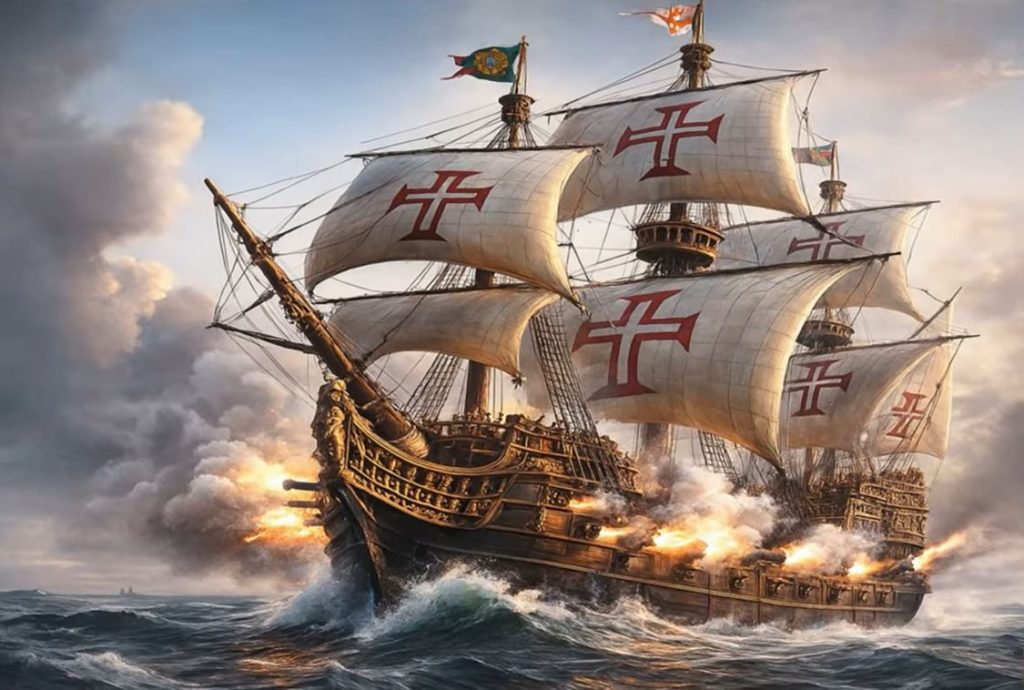
Celtic shipbuilding in its most developed form was the carrack – an ocean-going ship: large enough to be stable in heavy seas, and capacious enough to carry a large cargo and the provisions needed for very long voyages. They had a high rounded stern with aftcastle, forecastle and bowsprit at the stem. As the predecessor of the galleon, the carrack was one of the most influential ship designs in history; while ships became more specialized in the following centuries, the basic design remained unchanged throughout this period.
A carrack is a three- or four-masted ocean-going sailing ship that was developed in Portugal. In their most advanced forms, they were used by the Portuguese and Spaniards for trade between Europe, Africa and Asia.
These expeditions significantly impacted European perceptions of the world and eventually led to numerous European naval expeditions across the Atlantic, Indian, and Pacific Oceans, and land expeditions in the Americas, Asia, Africa, and Oceania.
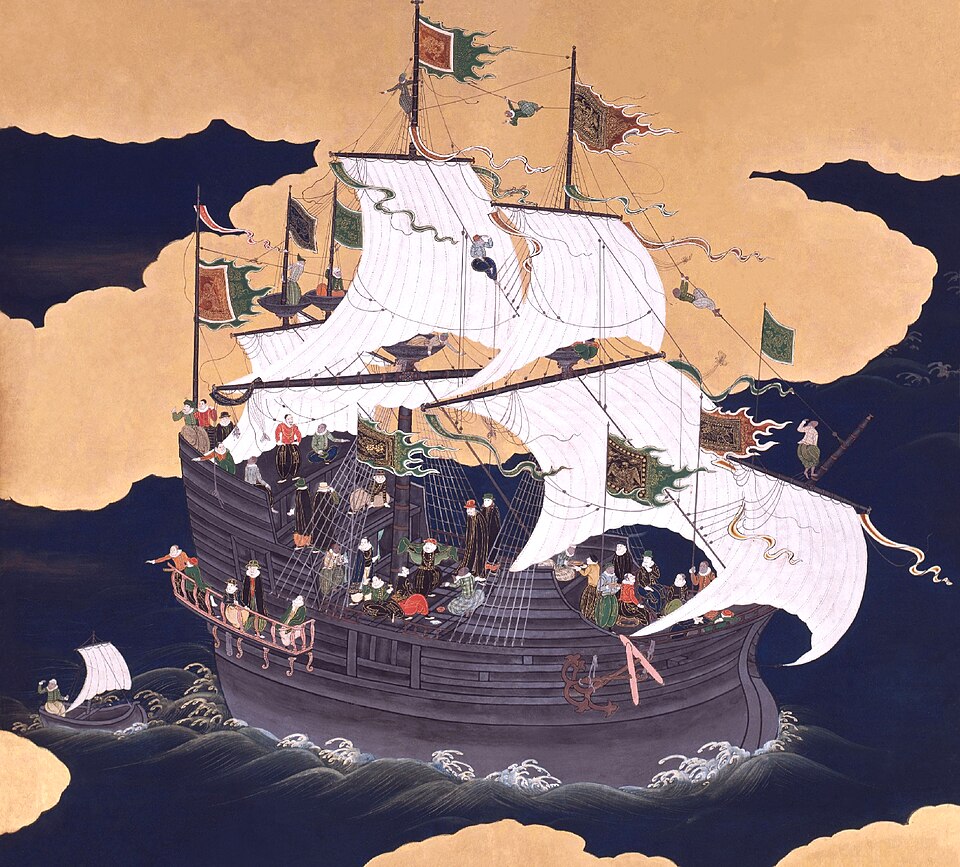
Spain also undertook other major voyages using the Carrack, including the Conquest of Mexico (1519–1521), the conquest of Peru (1532–1533), and the Manilla trade route (1565–1815), which linked the Americas and Asia across the Pacific.
The word carrack derives from the Celtic root word – car meaning to carry. From this Celtic root word we obtain such modern words as car, carry, chariot, cargo and carriage.
From its ancient beginnings, the Celtic tradition of shipbuilding continued well into the 16th Century. The warship São João Baptista, nicknamed “Botafogo” (“Spitfire”), was a Portuguese galleon built in 1534, considered the largest and most powerful warship at the time ever built in the world. The galleon was mounted 366 bronze canons with 5-gun decks. With a displacement of 1000 tons and 50 meters in length, the warship could also transport 600 musketeers, 400 swordsman and 300 artillerymen.
Celtic Language
The earliest written records of Europe come from southern Lusitania in what is now Portugal where the Celts originate from.
The Lusitanian language is the ancestral proto language of the Celtic language. That the Lusitanians had a written language dating back thousands of years is proved both by archaeological evidence and classical historical records.
Strabo around the year 30 BC states:
“The Turdetanians are ranked as the wisest of the Iberians; and they make use of an alphabet, and possess records of their ancient history, poems, and laws written in verse that are six thousand years old, as they assert.”
Strabo, Geographia, book 3, chapter 1.6
Strabo records the kingship of the Turdetanians and the Celts in southern Lusitania:
“Along with the happy lot of their country, the qualities of both gentleness and civility have come to the Turditanians; and to the Celtic peoples, too, on account of their being neighbours to the Turdetanians, as Polybius has said, or else on account of their kinship; but less so the Celtic peoples, because for the most part they live in mere villages. “Strabo, Geographia, book 3, chapter 2.15
This implies the Lusitanian-Celtic language has existed in an advanced written form since at least 6 000 BC.
This ancient relationship is further documented by Diodorus where he relates that Hamilcar, upon arriving in Southern Iberia in 237 BC, was opposed by “Iberians, Tartessians, together with the Celts, led by Istolatius and his brother”Diodorus Siculus, Library of History, book 25, Chapter 10, 1-3
The archaeological evidence comes primarily in the form of stone slabs, or steles, which contain inscriptions in the Celtic language. The Abóbada Stele, found in the district of Beja, Portugal is an 8th Century BC one of several relics showing Celtic writing. The district of Beja, Portugal is the same location where classical authors such as Herodotus, Pliny and Strabo placed the Celts.

Herodotus wrote of a wealthy Tartessian king named Arganthonios who reigned in the year 625 BC and in whose name we may recognise the Celtic word for ‘silver’ – ancient Celtic arganto.
When describing Europe, Pseudo-Sycmnus, possibly dating to 100 BC, wrote the flourishing city of Tartessos and the river by the same name, modern Guadalquivir, lay in the territory of the Celts and that it produced tin, gold and copper washed down by streams.
“After this, for one who has completed a voyage of two days, there is a most prosperous emporium, the so‑called Tartessus, a distinguished city, bringing down by river tin from Celtic land and a greater quantity of gold and bronze… the land from the west wind as far as the western setting the Celts possess”Pseudo-Sycmnus, Periegesis, chapter 150
The extent of Celtic peoples from the Atlantic in Southern Iberia to Southern France is evidenced by Sycmnus’ statement describing the people eastwards of Tartessus.
“Next is the country called Celtic as far as the sea that lies by Sardinia, which is the greatest people toward the west.”Pseudo-Sycmnus, Periegesis, chapter 150
The number of known Celtic inscriptions on stone in southern Lusitania is now about 90 and steadily rising with new discoveries. Concentrated densely in southern Portugal (the Algarve and Lower Alentejo). The best exhibition of the inscriptions is on view in charming provincial town of Almodôvar.
The find-spots are necropolises of the period (800–500 BC), showing that the inscriptions belong to a funerary tradition. In this respect they continue the 100 warrior stelae of the (1250–750 BC) period. In four apparently transitional monuments incised heroic images are combined with Tartessian texts.
The academic, historian, and linguist John T. Koch who specializes in Celtic studies believes Tartessian represents an archaic form of Q-Celtic, the earliest attested Celtic language. Koch’s hypothesis relies on onomastic parallels, such as personal names and toponyms, and interpretations of lexical items which he links to Proto-Celtic forms attested in later languages like Celtiberian and Gaulish.
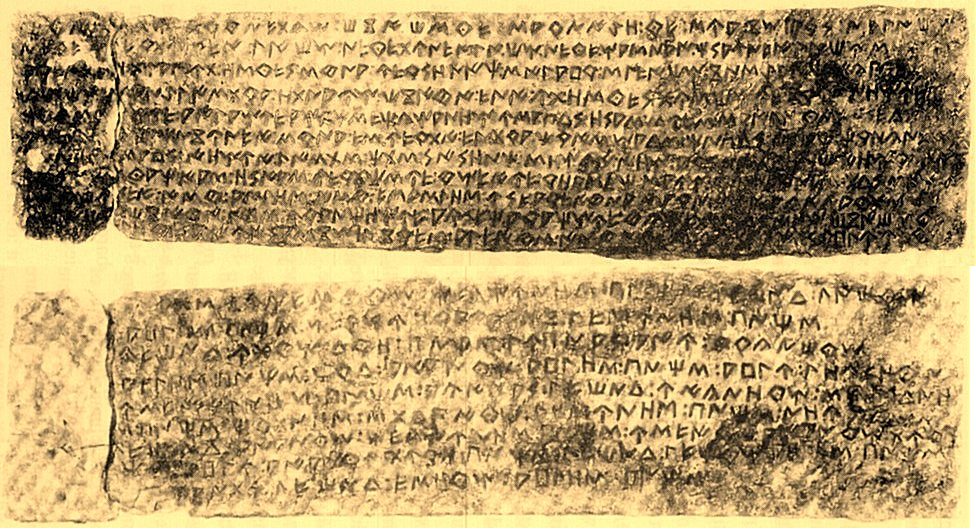
The Botorrita plaques are four bronze plaques discovered in Botorrita, near Zaragoza Celtiberia dating to the late 2nd century BC, known as Botorrita I, II, III and IV. The plaques are inscribed in the Celtic script.
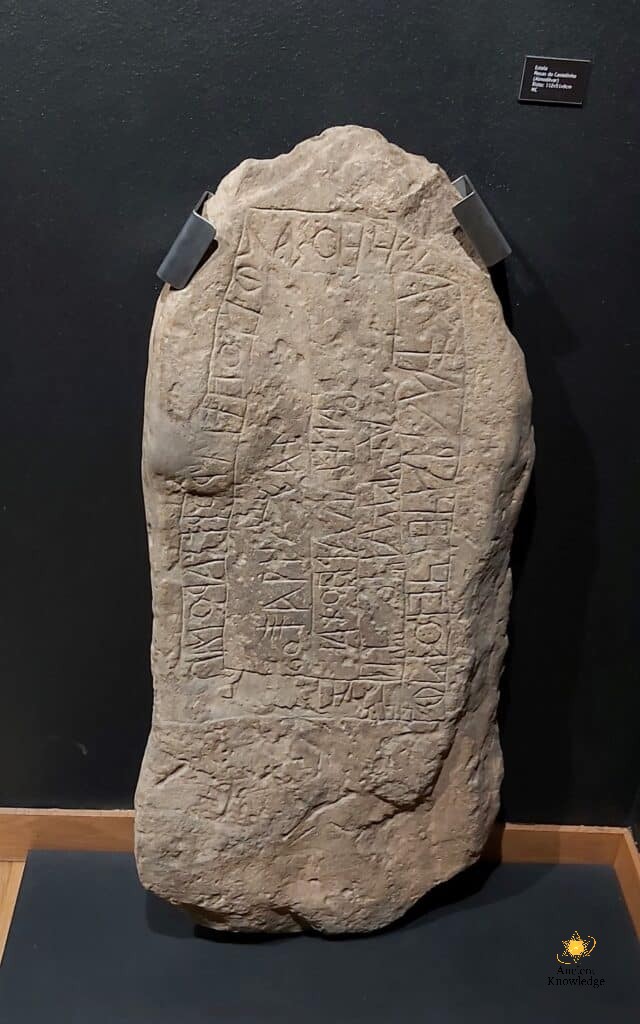
From an archaeological site in Almodôvar, Alentejo, Southern Portugal the stele, known as the Mesas de Castelinho stele, has further examples of Lusitanian Celtic script.
Celtic Cuisine
We have some written evidence of what Celts farmed and ate thousands of years ago. When describing the mode of life of the Lusitanian Celts Strabo states:
“All the mountaineers lead a simple life, are water-drinkers, they eat goat’s-meat mostly… and the mountaineers, for two-thirds of the year, eat acorns, which they have first dried and crushed, and then ground up and made into a bread that may be stored away for a long time. They also drink beer; but they are scarce of wine, and what wine they have made they speedily drink up in merry feastings with their kinsfolk; and instead of olive oil they use butter. They dine sitting down, for they have stationary seats built around the walls of the room, though they seat themselves forward according to age and rank. The dinner is passed round, and amid their cups they dance to flute and trumpet, dancing in chorus, but also leaping up and crouching low.”Strabo, Geographia, book 3, chapter 3.7
Traditional recipes of acorn bread continue to be produced and consumed in Portugal. In the southern Portuguese tradition, the acorn is not only used for bread production, but also soups, sweets and even liqueurs or coffee.

Athernaeus of Naucratis born in the 2nd century AD wrote the Deipnosophistae, a long work of historical and antiquarian references. In this work Athernaeus further describes the eating habits of the Celts:
“The Celts place food before their guests, putting grass for their seats, and they serve it up on wooden tables raised a little above the ground: and their food consists of a few loaves, and a good deal of meat brought up floating in water, and roasted on the coals or on spits. And they eat their meat in a cleanly manner enough, but like lions, taking up whole joints in both their hands, and gnawing them; and if there is any part which they cannot easily tear away, they cut it off with a small sword which they have in a sheath in a private depository. And those who live near the rivers eat fish also, and so do those who live near the Mediterranean Sea, or near the Atlantic Ocean; and they eat it roasted with salt and vinegar and cummin seed: and cummin seed they also throw into their wine. But they use no oil, on account of its scarcity; and because they are not used to it, it seems disagreeable to them. But when many of them supper together, they all sit in a circle ; and the bravest sits in the middle, like the coryphaeus of a chorus ; because he is superior to the rest-either in his military skill, or in birth, or in riches: and the man who gives the entertainment sits next to him; and then on each side the rest of the guests sit in regular order, according as each is eminent or distinguished for anything.”Athenaeus of Naucratis, Deipnosophistae, book 4, chapter 36
“And their armour-bearers, bearing their large oblong shields, called (θνρεοι), stand behind; and their spear-bearers sit down opposite in a circle, and feast in the same manner as their masters. And those who act as cup-bearers and bring round the wine, bring it round in jars made either of earthenware or of silver, like ordinary casks in shape, and the name they give them is a (αμβικοζ). And their platters on which they serve up the meat are also made of the same material; but some have brazen platters, and some have wooden or plaited baskets. And the liquor which is drunk is, among the rich, wine brought from Italy or from the country about Marseilles; and this is drunk unmixed, but sometimes a little water is mixed with it. But among the poorer classes what is drunk is a beer made of wheat prepared with honey, and oftener still without any honey; and they call it corma. And they all drink it out of the same cup, in small draughts, not drinking more than a serving beaker at a time; but they take frequent draughts: and a slave carries the liquor round, beginning at the right hand and going on to the left; and this is the way in which they are waited on, and in which they worship the gods, always turning towards the right hand. These now are the accounts of the Celts given by Posidonius in the third and in the twentieth books of his History.” Athenaeus of Naucratis, Deipnosophistae, book 4, chapter 36
We know the ancient Celts boiled meat stews that combine chunks of meat, most likely lamb, pork, goat and wild fowl with various vegetables and a flavourful liquid which was dipped into with bread.
Both meat and fish were also roasted over a fire and seasoned with salt, vinegar, garlic and cummin. Cheese from goats, sheep and cows was also manufactured. Evidence indicates that they utilized rough vessels over wood fires for cheese production as early as the 2nd century BC.
As a sweetener, the Celts used honey. Ancient rock art from Celtic Spain, particularly at sites like Barranco Gómez and Cuevas de la Araña, provides valuable insights into early human practices related to honey collection. These artworks date back approximately 7,500 to 8,000 years and depict scenes of prehistoric humans gathering honey from wild bees.
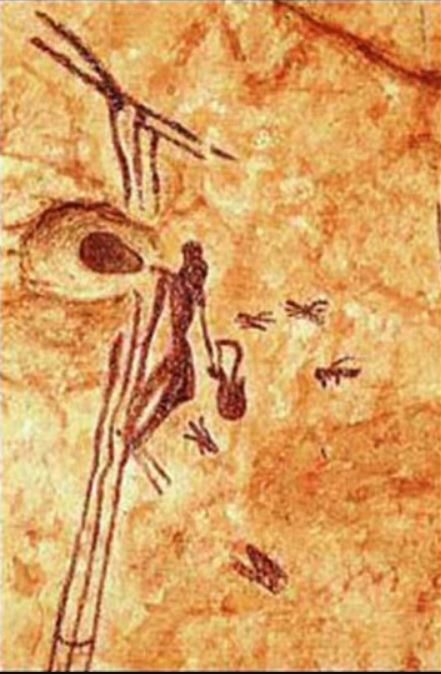
The Cuevas de la Araña rock art, known for the “Man of Bicorp,” shows a honey hunter navigating a rope ladder amidst a swarm of bees, emphasizing the dangers faced by these early gatherers.
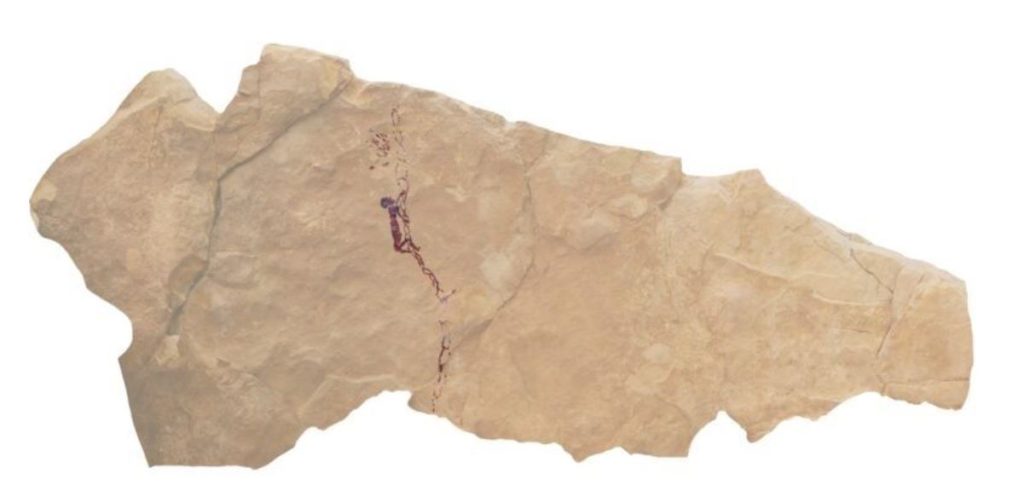
The Barranco Gómez honey hunting rock art in Castellote, Teruel, Spain has been dated to 5500 BC. It features a detailed painting of a figure climbing a rope ladder to reach a beehive. This scene illustrates the technical sophistication and risks involved in honey gathering.
Honey was a crucial source of nutrition for ancient humans, valued for its sweetness and energy content. The act of honey gathering depicted in these artworks highlights the lengths to which early Celtic peoples went to obtain this resource, showcasing their ingenuity and adaptability.
The tradition of honey collection likely persisted through in the region, highlighting its enduring value. Honey’s role illustrates the deep-rooted connection between the Celts and nature, particularly in the context of food sources and cultural practices.
Beer was produced by the ancient Celts used basic fermentation processes and the local brew known as ‘Caelia’ was consumed by warrior peoples before battles, highlighting its cultural significance. This tradition dates back more than 5,000 years. Beer held a vital role in the social and ritual practices of ancient Celtic societies. It was not only a beverage but also a part of pre-battle rituals, indicating its importance in communal and warrior culture.
Beers made in Celtic Lusitania utilized a variety of grains such as barley, wheat and sometimes included herbs, spices and honey, reflecting regional tastes and agricultural practices. The tradition of brewing in ancient Lusitania reflects a rich cultural heritage that parallels other ancient civilizations, emphasizing the importance of beer in social and ritual contexts.
The first century historian Pliny the Elder (23AD – 79AD) explained:
“different beverages, too, are made from the cereals, zythum in Egypt, cælia and cerea in Spain, cervesia and numerous liquors in Gaul.“Pliny the Elder, Natural History, book 22, chapter 82
Additionally, Paulus Orosius (375 AD – 418 AD) indicated these indigenous Celtiberians would sometimes fight after:
“they had just drunk their fill…of a juice made from wheat. This drink is skillfully concocted, and it is called caelia because it is heated. The potency of the moistened fruit bud is first intensified by heat. The bud is then dried, ground to powder, and mixed with a mild juice. When this ferments, it becomes sour and when consumed produces that feeling of warmth characteristic of drunkenness. They drank this potion after their long fast and as soon as it took effect presented themselves for battle.” Orosius, Against the Pagans, Book 4, chapters 12
A series of archaeological surveys and excavations has been undertaken, both in settlements and tombs, two of which are those with the Bell Beakers whose chemical analysis identifies the existence of a primitive wheat beer. This is compared with other new analyses in Iberia, from both Neolithic and Copper Age sites, which also demonstrate the use of alcoholic beverages. The two Ambrona Valley, Celtiberia examples are Copper Age Bell Beaker intrusions into earlier Middle Neolithic Monumental graves.
The La Peña Beaker grave goods are composed of six pottery vessels and a small quadrangular golden ornament. All of the Beaker ceramics were of Maritime Style (three Bell Beakers, a carinated bowl, and a small carinated bowl), which is entirely characteristic of such finds in the Celtiberian interior highlands. Chemical analysis of residues in one of the Bell Beakers indicated the presence of a primitive form of wheat beer.Beer and Bell Beakers: Drinking Rituals in Copper Age Inner Iberia by Manuel Ángel Rojo-Guerra, Rafael Garrido-Pena, Ísigo García-Martinez de Lagran, Jordi Juan-Treserras and Juan Carlos Matamala
Celtic Musical Instruments
The Celts utilized a diverse range of musical instruments that were integral to their cultural and social practices. These instruments not only provided entertainment but also played significant roles in traditional rituals and cultural gatherings. Instruments such trumpets, harps, fiddles, gaitas, drums, flutes and lyres.
These instruments were not only tools for music but also symbols of identity and heritage among the Celtic peoples. The trumpet, for example, was prominently featured in military contexts, while the harp and fiddle were central to social gatherings and storytelling traditions. Drums were essential for dance music, highlighting the communal aspect of Celtic musical practices.

When describing the Lusitanians way of life Strabo states:
“they dance to flute and trumpet, dancing in chorus, but also leaping up and crouching low.”Strabo, Geographia, book 3, chapter 3.7
Diodorus Siculus recorded:
“In time of peace, they practice a kind of elfin dance which requires great nimbleness of limb” Diodorus Siculus, Library of History, book 5, Chapter 34.5-35

When describing the Celts Diodorus states:
“Their trumpets are of peculiar nature and such as barbarians use, for when they are blown upon, they give forth a harsh sound, appropriate to the tumult of war. “Diodorus Siculus, Library of History, book 5, Chapter 30
The trumpet used by the Celts was a long, valveless horn made of bronze, often used in warfare to intimidate enemies.

“These men sing to the accompaniment of instruments which are like lyres, and their songs may for either of praise or of obloquy.” Diodorus Siculus, Library of History, book 5, Chapter 31
The lyre is a stringed musical instrument consisting of two arms and a crossbar. Homer in the 8th century BC described two different types western lyres in his writings.

Tartessian Lyre by Yerco Lorka
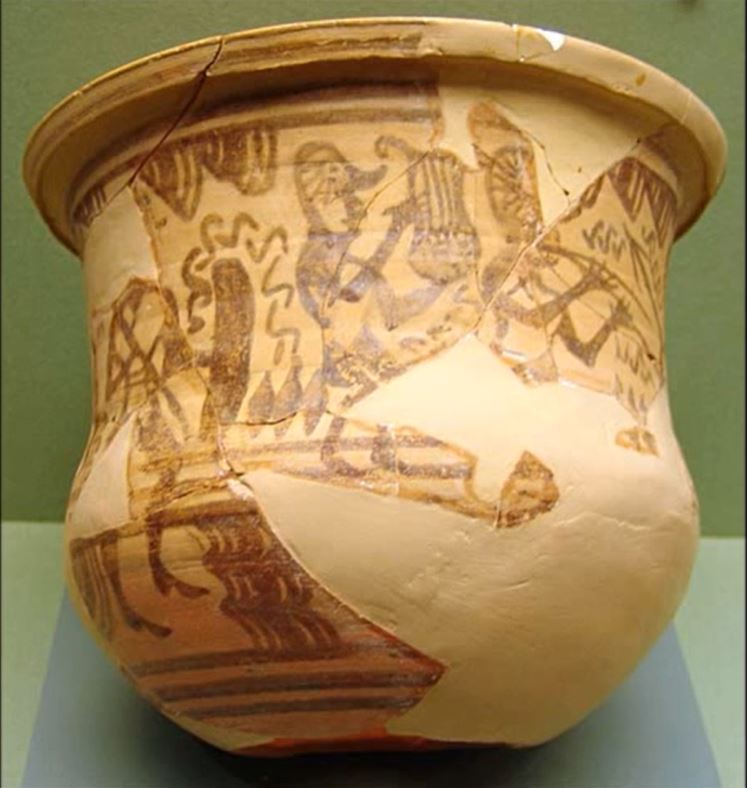
The Gaita is an air-based instrument whereby the player inflates the bag using his mouth through a tube fitted with a non-return valve. Air is driven into the opening, known as the punteiro, with the left arm controlling the pressure inside the bag. Finger-holes include three for the left hand and four for the right, as well as one at the back for the left thumb.

Lusitanian Gaita and Drum Players – Coimbra, Portugal
Dancing in chorus is a traditional way of dancing in Celtic Portugal, Galicia and Spain and till this day continues to be a much cherished event during the local festivities of each region.
Galician Gaita and Dancing
Overall, the variety of instruments reflects the rich musical heritage of the Celts, which continues to influence music today.
Ancient Celtic Warfare
The warfare of the Celts evolved over time but the Celt warriors were known for their fierce and courageous combat style by ancient historians. This reputation contributed to their warrior like image in the ancient world.
The Celts used both heavy infantry, light infantry, spearman, javelin throwers, archers, slingers and cavalry units in battle and used the natural landscape for ambushes and guerilla tactics. The Celts also held military style contests of different types and some Celtic kings retained poets to sing their praises and historical feats while marching to battle.
“I gather that the Celts face danger more boldly than other races. Certainly they make heroic death in war the subject of their poems. In battle they wear garlands on their heads and they put up victory monuments; they take pride in their achievements and leave behind them memorials of their bravery, in Greek style. To run away is held to be so shameful that they often will not even escape if a house collapses and falls on them, nor if the house is on fire and they are caught by the flames. Many of them stand firm as the sea washes over them. Some pick up weapons, rush into the waves, and feel their impact, brandishing naked swords and spears, as if these could frighten or wound them.” Claudius Aelianus, Historical Miscellany, book 12, chapter 23
When describing the Celtiberians Diodorus states:
“And this people, it would appear, provide for warfare not only excellent cavalry but also foot-soldiers who excel in prowess and endurance. They wear rough black cloaks, the wool of which resembles the hair of goats. As for their arms, certain of the Celtiberians carry light shields like those of the Gauls, and certain carry circular wicker shields as large as an aspis and about their shins and calves they wind greaves made of hair and on their heads, they wear bronze helmets adorned with purple crests. The swords they wear are two-edged and ‘wrought of excellent iron, and they also have dirks a span in length which they use in fighting at close quarters.”Diodorus Siculus, Library of History, book 5, Chapter 33
“And a peculiar practice is: followed by them in the fashioning of their defensive weapons; for they bury plates of iron in the ground and leave them there until in the course of time the rust has eaten out what is weak in the iron, and what is left is only the most unyielding, and of this they then fashion excellent swords and such other objects as pertain to war. The weapon which has been fashioned in the manner described cuts through anything which gets in its-way, for no shield or helmet or bone can withstand a blow from it, because of the exceptional quality of the iron.”Diodorus Siculus, Library of History, book 5, Chapter 33
In 104 BC the Celtiberians defeated the Germanic Cimbrians who attempted to invade northern Iberia. Livius states:
“Having devastated everything between Rhône and Pyrenees, the Cimbrians moved through a mountain pass into Iberia, where they were – after having devastated many districts – routed by the Celtiberians. They returned to Gaul and joined the Teutons in the land of the Veliocassians.”Livy, Periochae, book 66-70
“Celts carried on a guerilla warfare in swamps, in pathless forests, and in deserts; and they made the ignorant Romans believe to be far away what was really near at hand, and kept them in ignorance of the roads and of the facilities for procuring provisions and other necessities.” Strabo, Geographia, book 1, chapter 1.17
“the Lusitanians, it is said, are given to laying ambush, given to spying out, are quick, nimble, and good at deploying troops. They have a small shield two feet in diameter, concave in front, and suspended from the shoulder by means of thongs (for it has neither arm-rings nor handles), Besides these shields they have a dirk or a butcher’s- Most of them wear linen cuirasses; a few wear three crests, but the rest wear helmets made of sinews. The foot-soldiers wear greaves also, and each soldier has several javelins; and some also make use of spears, and the spears have bronze heads.”Strabo, Geographia, book 3, chapter 3.6

The use of a small round shield by Celtic warriors continued till the 16th Century. When the Spanish Conquistadors arrived in the Americas they took with them the “rodela” shield, a circular, convex steel shield also roughly 2 feet in diameter, just like the shields described as being used by the Celts over a thousand years earlier in the 2nd Century BC. The rodela was used to deflect blows from the native Americans and was a primary defense for the infantrymen. These steel shield bearing infantrymen were called Rodeleros, meaning shield bearers, were also equipped with swords and spears.
Rodeleros formed the backbone of Hernán Cortés’ expeditions during the conquest of the Aztec Empire from 1519 to 1521, comprising the majority of the Spanish infantry in an era of asymmetric warfare against numerically superior foes. Bernal Díaz del Castillo, a participant in the campaigns who served as a rodelero equipped with a sword and buckler, chronicled these events in his eyewitness account Historia verdadera de la conquista de la Nueva España, emphasizing the soldiers’ role in close-quarters charges and defensive stands. Rodeleros adapted tercio tactics by forming tight shield walls to advance against Aztec warriors, their steel armor and swords providing a technological edge over obsidian weapons. Upon landing near Veracruz in 1519, Cortés commanded around 550 soldiers, the bulk of whom were rodeleros protected by steel helmets, breastplates, and round steel shields that deflected arrows and slings.
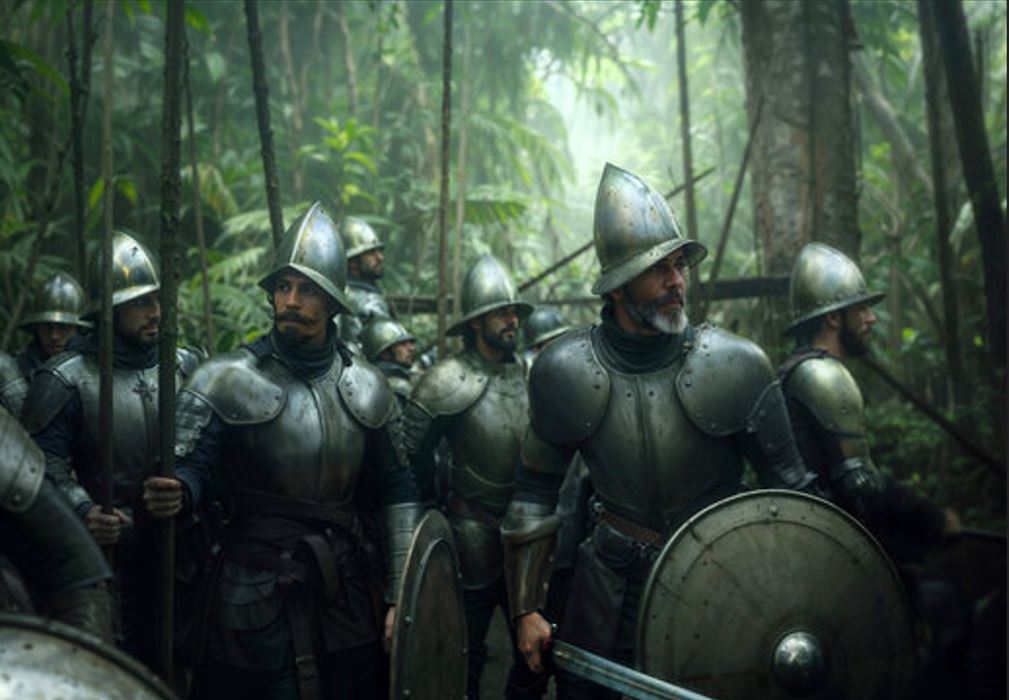
Celtic people attribute a high importance to their round metal shield. The Portuguese word “escudo” means “shield” and was also the name of Portugal’s currency from 1911 until 2002.
“And intermingled with their forces of infantry was a force of cavalry, for their horses were trained to climb mountains, and, when- ever there was need for it, to kneel down promptly at the word of command. “Strabo, Geographia, book 3, chapter 4.15
Regarding the Lusitanians:
“in their wars they march into battle with even step and raise a battle-song as they charge upon the foe.”Diodorus Siculus, Library of History, book 5, Chapter 34.5-35
“In these same days, three hundred Lusitanians fought an engagement against a thousand Romans in a mountain valley. Claudius reports that in this battle seventy Lusitanians and three hundred and twenty Romans lost their lives. When the victorious Lusitanians had scattered and were withdrawing in safety, one of them, a foot soldier, was cut off at some distance from his companions. When Roman cavalrymen suddenly surrounded him, he pierced the horse of one of his assailants with his spear and beheaded the rider with a single blow of his sword. All the others were so terrified that he was able to walk off leisurely and in a contemptuous manner while they looked on.”Orosius – Against the Pagans, book 5, chapter 5
The Lusitanian heavier infantry warriors also used larger oval shields.
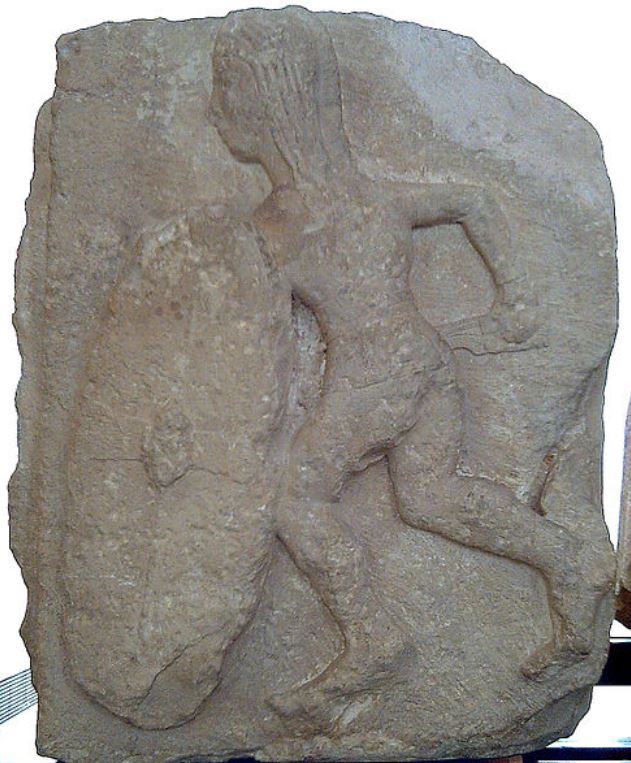
The classical Latin poet Virgil wrote:
“Then Rome was poor; and there you might behold
The palace thatched with straw, now roofed with gold.
The silver goose before the shining gate
There flew, and, by her cackle, saved the state.
She told of the Gauls’ approach; the approaching Gauls,
Obscure in night, ascend, and seize the walls.
The gold dissembled well their yellow hair,
And golden chains on their white necks they wear.
Gold are their vests; long Alpine spears they wield,
And their left arm sustains a length of shield“Virgil, The Aeneid, book 8
While Greek historians referred to the Lusitanian people as “Celts,” using the term “keltoi” to describe Celtic tribes, the Latin historians adopted the term “Gauls” to denote the same people.
The Celts wore bronze helmets with either a low or high crest. The crests are said to have been purple or crimson. The most common headwear seems to have been a simple helmet of bronze or leather, occasionally extended at the back to form a neck guard and with cheek guards added at the sides. Strabo says the Lusitanians wore helmets of sinew with a crest, and sculptures in southern Lusitania do show some form of crested cap or hood. Diodorus Siculus says the Celtiberians wore helmets of brass or copper with red plumes.
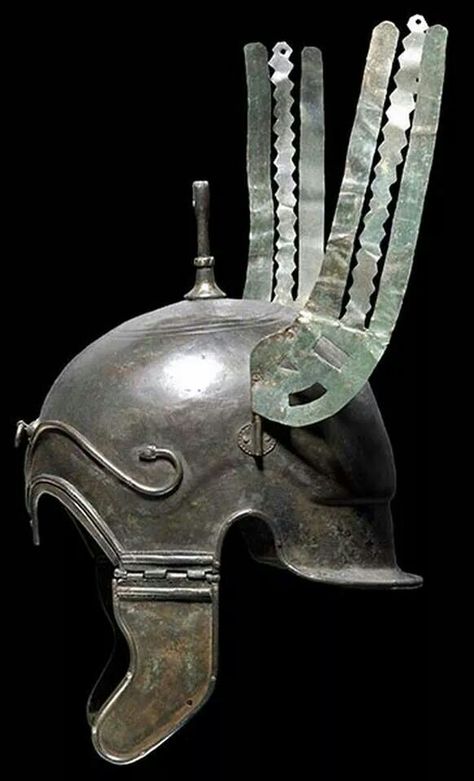

“Less nimble on their feet are the horses from Uxama…but her steeds that came to war were tenacious of life; their lusty youth found it hard to endure the bit or obey the commands of the rider. These men were led by Rhyndacus and armed with spears; they add terror to their helmets by decking them with the open jaws of wild beasts”Silius Italicus, Punica, chapters 381-403

The Falcata type sword was the most emblematic weapon used by the Celt warriors. It was without a doubt their weapon of choice for over several centuries. This can be said due to the large amounts of these swords found on excavation sites throughout Portugal and Lusitania.
According to the classical texts, the Falcata used by the Celts was manufactured to perfection. Lusitanian warriors maintained a spiritual connection to their swords and when they died their swords were buried with them. Diodorus reports that the Falcatas were of such superior quality that no helmet, shield or bone could resist its devastating effect.

A descendent of the Lusitanian Falcata sword was the Falchion sword used in the 16th Century by the Spanish Conquistadors in the New World. Just like the Falcata, the Falchion is a slashing specialist featuring a curved single edged blade that widens towards to tip perfect for quick cuts and used by the cavalry.
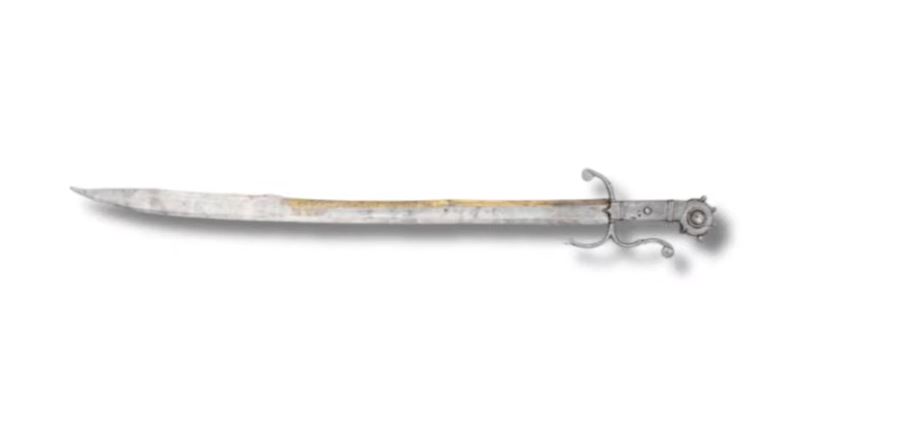
“The most valiant among the Iberians are those who are known as Lusitanians, who carry in war very small shields which are interwoven with cords of sinew and are able to protect the body unusually well, because they are so tough; and shifting this shield easily as they do in their fighting, now here, now there, they cleverly ward off from their person every blow which comes at them. They also use barbed javelins made entirely of iron, and wear helmets and swords very much like those of the Celtiberians, they hurl the javelin with good effect, even over a long distance, and, in fine, are doughty in dealing their blows. Since they are nimble and wear light arms, they are swift both in flight and in pursuit”Diodorus Siculus, Library of History, book 5, Chapter 34, 1-5

“It is also their custom, when they are formed for battle, to step out in front of the line and to challenge the most valiant men from among their opponents to single combat, brandishing their weapons in front of them to terrify their adversaries. And when any man accepts the challenge to battle, they then break forth into a song in praise of the valiant deeds of their ancestors and in boast of their own high achievements, reviling all the while and belittling their opponent, and trying, in a word, by such talk to strip him of his bold spirit before the combat. “Diodorus Siculus, Library of History, book 5, Chapter 29
“Able as they are to fight in two styles, they first carry on the contest on horseback, and when they have defeated the cavalry they dismount, and assuming the role of foot-soldiers they put up marvellous battles.”Diodorus Siculus, Library of History, book 5, Chapter 33, 33-34
Celt and Iberian cavalry fought alongside Spartan warriors in 369 BC at Corinth where they aided Sparta against Thebes. These Celts and Iberians were sent by Dionysius I of Syracuse and were praised for their effectiveness in combat, helping to secure a victory during the decline of Spartan power. The Celts warriors were part of a force of over 20 triremes that brought reinforcements, including cavalry, which successfully engaged the Thebans.
The Greek military leader and historian, Xenophon of Athens, wrote the following about Celt cavalry tactics:
“At the date of the above transactions the Lacedaemonians were cheered by the arrival of a naval reinforcement from Dionysius, consisting of more than twenty warships, they brought Celts and Iberians and about fifty of their cavalry. The day following, the Thebans and the rest of the allies, posted, at intervals, in battle order, and completely filling the flat land down to the sea on one side, and up to the knolls on the other which form the buttresses of the city, proceeded to destroy everything precious they could lay their hands on in the plain.
The Athenian and Corinthian cavalry, eyeing the strength, physical and numerical, of their antagonists, kept at a safe distance from their armament. But the little body of cavalry lately arrived from Dionysius spread out in a long thin line, and one at one point and one at another galloped along the front, discharging their missiles as they dashed forward, and when the enemy rushed against them, retired, and again wheeling about, showered another volley. Even while so engaged they would dismount from their horses and take breath; and if their foemen galloped up while they were so dismounted, in an instant they had leapt on their horses’ backs and were in full retreat. Or if, again, a party pursued them some distance from the main body, as soon as they turned to retire, they would press upon them, and discharging volleys of missiles, made terrible work, forcing the whole army to advance and retire, merely to keep pace with the movements of fifty horsemen.”Xenophon, Hellenica, Book 7, chapter 1
On a second engagement against the Thebans near Laconia:
“Presently, when Archidamus led the advance, a few only of the enemy cared to await them at the spear’s point, and were slain; the mass of them fled, and fleeing fell. Many were cut down by the cavalry, many by the Celts. When the battle ceased and a trophy had been erected, the Spartan at once dispatched home Demoteles, the herald, with the news. He had to announce not only the greatness of the victory, but the startling fact that, while the enemy’s dead were numerous, not one single Lacedaemonian had been slain.”Xenophon, Hellenica, Book 7, chapter 1
Strabo tells us about Celtic use of horses in warfare:
“they ride double on horseback, though in the time of battle one of the two fights on foot” Strabo, Geographia, book 3, chapter 4.18
The Celts in Lusitania also used slingers as part of their military tactics, often employing them in ambushes and skirmishes. Slingers were integral to Lusitanian warfare, often positioned at the front lines to harass enemy forces before the main infantry engaged. Lusitanian slingers typically used slings made from plant fibers and animal sinews. They would carry multiple slings for different ranges, allowing them to adapt to various combat situations.
The slingers would launch projectiles, such as stones or lead bullets, at enemy troops, causing significant disruption and damage. Their ability to strike from a distance made them valuable in both offensive and defensive operations. In summary, slingers were a key component of the Lusitanian military strategy, contributing to their reputation as skilled warriors in ancient conflicts.

Spears were the main offensive weapon used by Celt warriors, often employed in both throwing and thrusting forms during battles. They were integral to the tactics of light infantry and cavalry who utilized them alongside javelins and swords in combat.
“The spears they brandish, which they call (lanciae), have iron heads a cubit in length and even more, and a little under two palms in breadth; for their swords are not shorter than the javelins of other peoples, and the heads of their javelins are larger than the swords of others. Some of these javelins come from the forge straight, others twist in and out in spiral shapes for their entire length, the purpose being that the thrust may not only cut the flesh, but mangle it as well, and that the withdrawal of the spear may lacerate the wound.”Diodorus Siculus, Library of History, book 5, Chapter 30
To this day, the Celt word “lança“ continues to mean “spear” in Portugal.


Lusitanian warriors and other Celts also used flotation devices such as bladders, most likely made of inflatable goat skins or Ox skins, allowing them to perform tactical river crossings effectively.
“They who had gone out to get forage or corn, were chased by the light troops of the Lusitanians, and the targeteers of Hither Spain, who were well acquainted with the country, and could readily swim across the river, because it is the custom of all those people not to join their armies without bladders.”Julius Ceasar, De Bello Gallico and Other Commentaries, book XLVIII
“The Celts who have added to their name that of the Hiberi came also. To these men death in battle is glorious; and they consider it a crime to burn the body of such a warrior; for they believe that the soul goes up to the gods in heaven, if the body is devoured on the field by the hungry vulture.”Silius Italicus, Punica, Book 3, chapters 330-356
The Bronze Age stelae from La Pimienta, Badajoz, Lusitania, shows two warriors with swords, a bow and arrow, a large shield, and spear.
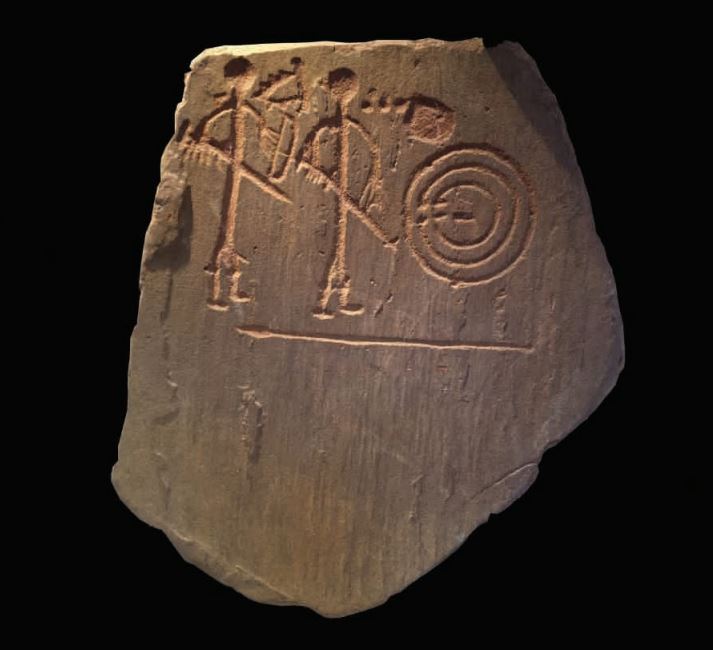
The Bronze Age stelae Cabeza del Buey from Badajoz is composed of four warrior figures, two of whom wear horned helmets in the upper section. The middle section features a chariot with a team of two horses and reins as the central motif around three other warriors. Finally, at the bottom of the piece, there is an inscription in Lusitanian Tartessian.
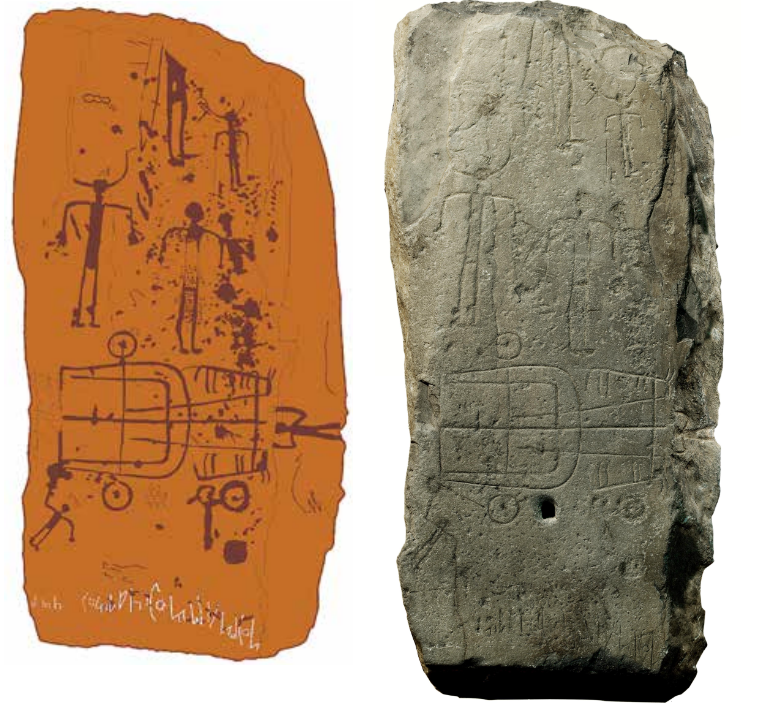
Spartacus’s army included many peoples, such as Celts, Gauls, Thracians, Germans and others who joined his rebellion during the Third Servile War against Rome. While Spartacus was a Thracian, Celts, including leaders like Crixus, Gannicus, Castus and Oenomaus, joined and led Spartacus’s forces during the rebellion.
This diverse group swelled his ranks to around 70,000 at its height. The inclusion of Celts and Gauls, along with other groups, provided Spartacus with a wide range of fighting skills and strategies, enhancing the effectiveness of his forces against the Romans. This diverse composition was crucial in the early successes of the rebellion, allowing Spartacus to achieve multiple victories before his eventual defeat.
In the winter of 71 BC, Gannicus, along with Castus, broke off from Spartacus, taking a large number of Celts and Germans with them, marking the second detachment of the rebellion. Gannicus and Castus met their end at the Battle of Cantenna in Lucania near Mount Soprano (Mount Camalatrum), where Marcus Licinius Crassus, Lucius Pomptinus and Quintus Marcius Rufus entrenched their forces in battle and defeated them.
The warrior tradition of the Celts dates back several millennia. The Magacela stele is a warrior stele found in Badajoz, Lusitania. The carved surface of the stele features a schematic human figure depicting a male warrior or chieftain wearing a helmet with horns, a spear and a carved round shield.
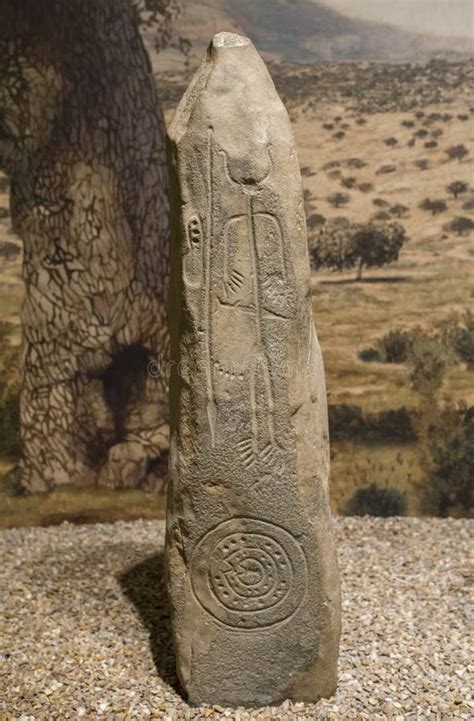
Celtic Martial Art
The Jogo do Pau is combative art focusing on the use of a wooden stick of fixed measures and characteristics. Defined as a martial art of traditional Portuguese and Galician Celtic folk origin, Jogo do Pau is a form of fencing where a stick, preferably made of wood, served as a weapon. It was used for self-defense and also to settle feuds and matters of honour between individuals, families, and villages. Many Portuguese migrants skilled in these methods introduced this art to Brazil and elsewhere.
The popularity of this martial art was partly due to the demeanor of the Celtic folk, who valued personal and family honor enough to kill. It was also due in no small part to the relative ease of obtaining a staff as well as the versatility of such a tool: a staff or stick was almost universally present, used as a support for the long daily walks, to help crossing rivers, used by shepherds to protect the cattle from wild animals, and so on.
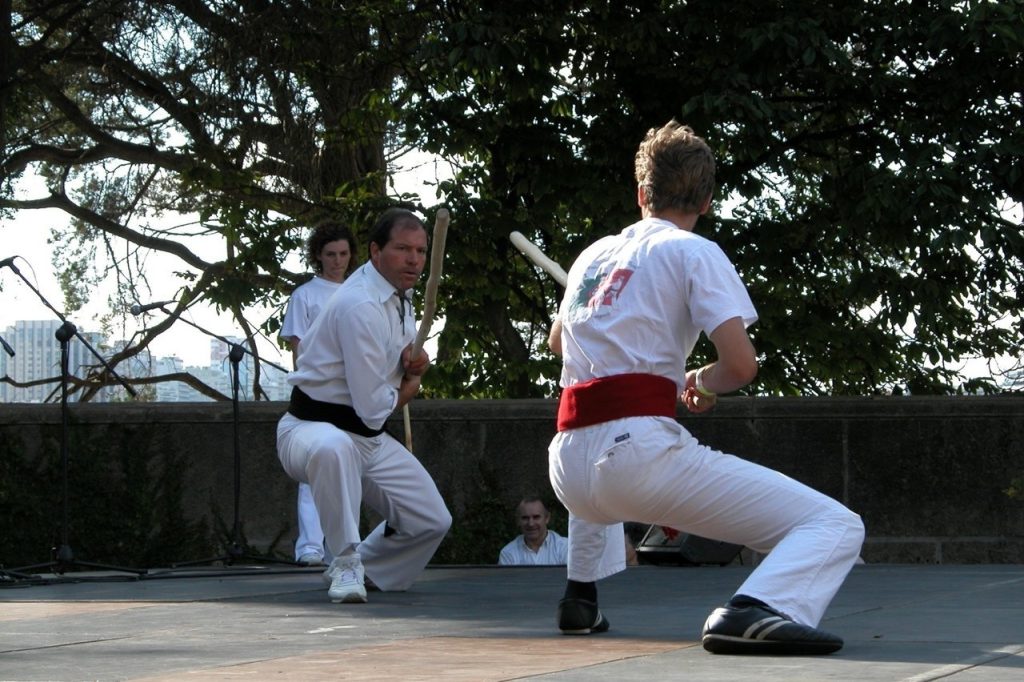
There are references to this martial art being used by the Portuguese guerrillas against the troops of Napoleon that were occupying Lisbon during the Peninsula War. Evidence of this art was first recorded in reports on the Battle of Aljubarrota of 1385. The concept bears similarities with the Celtic French bâton de combat which implies there could be a much older common link to other Celtic peoples such as the Galicians and Bretons traditional wood stick fighting as all of these are Celtic regions. This distinct Celtic martial art is practiced today although relatively small, the sport has been revitalised and maintains a number of practitioners organized in two federations: the Federação Portuguesa de Jogo do Pau and the Federação Nacional do Jogo do Pau Português.
This art is practised in Lisbon, the Azores and Madeira islands, and outside of Portugal sporadically in Galicia, Spain and Brazil. Often referred to in Portugal as national fencing, this has been revived less as warlike technique and more of a sport, combining tradition and moderate pedagogical processes. While adhering to cultural heritage, the use of traditional village suits and belts/shashes adapted to contemporary environments, has been reinstated in some schools.
Dress Habits of the Celts
Wool manufacture by the Celts in Lusitania was a significant aspect of textile production, deeply intertwined with the region’s Celtic cultural identity and economic activities. When speaking of the different types of wool production Pliny states:
“so too is that which Salacia, in Lusitania, finds the most useful for making its chequered cloths” Pliny the Elder, Natural History, book 8, chapter 73
“All the men dress in black, for the most part in coarse cloaks…but the women always go clad in long mantles and gay-coloured gowns.”Strabo, Geographia, book 3, chapter 3.7
“men let their hair stream down in thick masses after the manner of women, though before going into battle they bind their hair about the forehead”Strabo, Geographia, book 3, chapter 3.6-7
Celtic Wool Weaving
Ancient Celts primarily used warp-weighted looms. These vertical wooden frames featured rows of strings (warps) that hung down, kept taut by groupings of baked clay or ceramic weights.
At the Cabezo Redondo archaeological site a 3,500-year-old Bronze Age weaving loom was remarkably preserved by fire. This discovery gave archaeologists direct evidence of how the wood frame was constructed, showing they used local Aleppo pine. The archaeologists also found unusually light loom weights (around 200 grams). This suggests the weavers were creating specialized, fine, and high-quality wool twills.
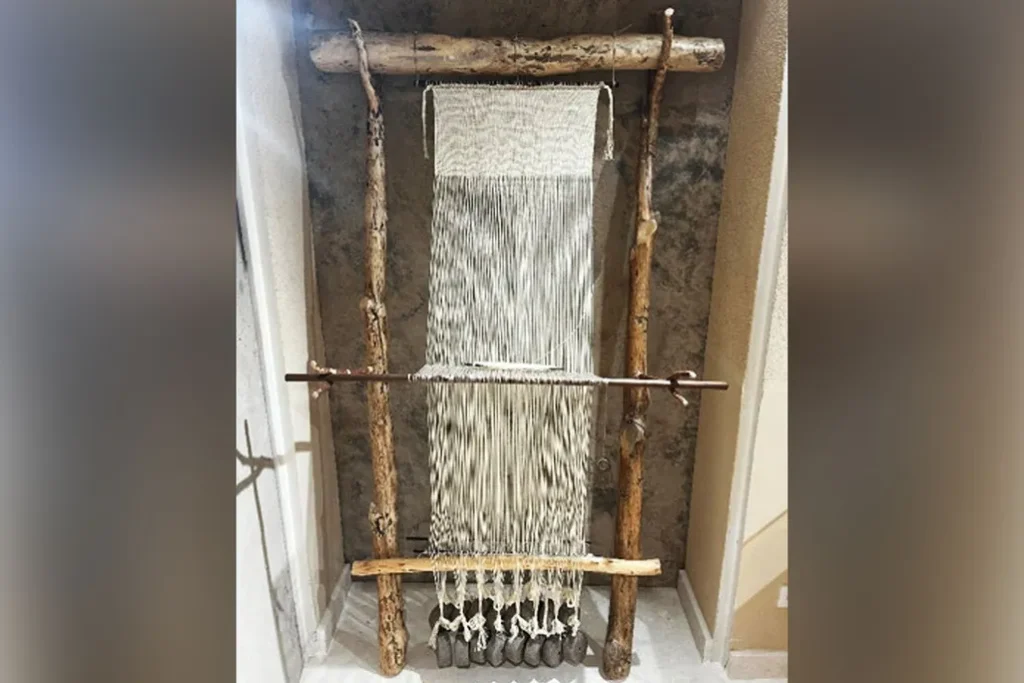
In even older Neolithic sites (such as the Peñacalera Cave near Córdoba), archaeologists discovered ancient textile fragments alongside ceramic crescents, suggesting early weavers used a variety of twisting tools to create warp twining before the widespread adoption of full looms.
While Neolithic textiles of the Celts in Iberia were primarily tabby-woven plant fibers like flax – linen, the adoption of sheep’s wool brought a major shift in fabric production.
Cave deposits in Sierra Morena, Lusitania have yielded some of the oldest loom-woven textiles in western Europe (dating to the 4th millennium B.C.E.), including early fabrics colored with mineral pigments like cinnabar.
Ancient Celtic weavers were connected to wider trade networks. Fine wool twills from the 5th-century BC site of Casas del Turuñuelo in Lusitania are the earliest wool twill fabrics found in Iberia.
The world renowned Merino sheep originated in Lusitania particularly in modern Galicia and Portugal. The breed is known for its fine wool and has a rich history influenced by various breeding practices.
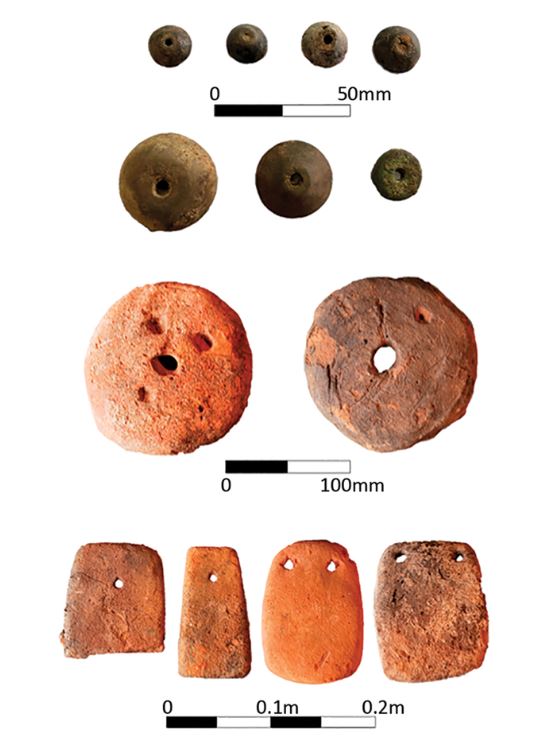
Textile tools recovered at Casas del Turuñuelo include 24 spindle whorls and 36 loom weights. The analysis of textile tools provides important information about textile production. The functional characteristics of spindle whorls and loom weights, for example, allows a reconstruction of the type of thread that was spun and the quality of the resulting cloth by studying the functional characteristics of spindle whorls and loom weights (Mårtensson et al. Reference Mårtensson, Nosch and Strand 2009; Andersson Strand & Nosch Reference Andersson Strand and Nosch 2015).
The rare survival of textile fragments at Casas del Turuñuelo Lusitania permits a comparison of the evidence provided by analysis of both the structural characteristics of the textiles and the textile tools.
We have from the written record:
“Formerly much cloth came from Turdetania, but now, wool, rather of the raven-black sort. And it is surpassingly beautiful; at all events, the rams are bought for breeding purposes at a talent apiece. Surpassing, too, are the delicate fabrics which are woven by the people of Salacia.”Strabo, Geographia, book 3, chapter 2.6
Religion of the Celts
The Celtic religion refers to the spiritual beliefs and practices of the Celts as practiced in their homeland of Lusitania. The religion of the Celts shares similarities with other ancient European religions, particularly in the worship of a pantheon of deities, which often included gods associated with nature and fertility.
Through the Celtic inscriptions and historical texts a great pantheon of Celtic deities begins to emerge. Worship practices involved various rituals, including sacrifices, often of bulls, to honor the gods. Inscriptions and altars found in the region provide evidence of these practices, indicating a rich tradition of devotion.
We know from Strabo:
“the Celtiberians and their neighbours on the north offer sacrifice to a nameless god at the seasons of the full moon, by night, in front of the doors of their houses, and whole households dance in chorus and keep it up all night.” Strabo, Geographia, book 3, chapter 4.16
We know the Celts worshipped Zeus.
“The Celts, indeed, venerate Jupiter [Zeus], but the Celtic statue of Jupiter [Zeus] is a lofty oak.”Cassius Maximus Tyrius, Dissertations, Dissertation 38
Other known deities of the Celts:
Hesus – a Celtic god known from various sources, including literature and inscriptions, often associated with trees and human sacrifices.
- “Hesus is the name given by the Gauls to Mars, who is appeased with human blood”Adnotationes super Lucanum, 1.445
- “Hesus Mars is appeased in this way: a man is fixed to a tree until his limbs are divided as a result of the bloodshed.”Commenta Bernensia ad Lucan, 1.445
- “Esus, that is Mars”Glossen ad Lucan
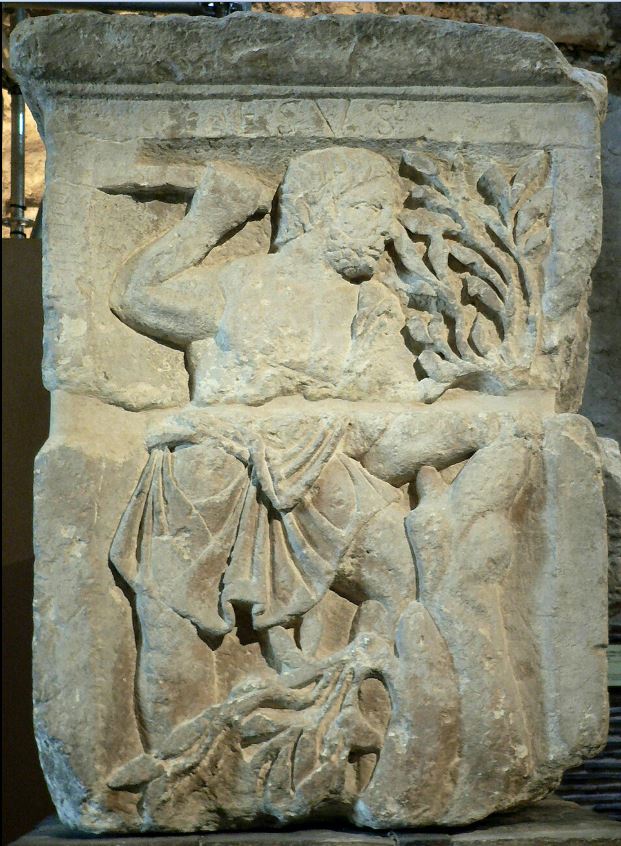
Reve (Reue/Reo) – sky god associated with lightning, thunder and mountains, with authority to sit in judgement of the other gods, and seen as the protector of man.
Reo or Reus is a name appearing on dedications to a Lusitanian Celtic deity, usually with an epithet relating to a place, such as Reo Paramaeco discovered in Lugo in Galicia. Reve is considered to be a very diffused deity in Lusitania which would indicate it was the most popular of the Lusitanian pantheon. The name appears in at least 20 inscriptions. The first element Reo/Reus is very similar to the name Reue appearing on the Lusitanian Cabeço das Fráguas inscription, part of which reads INDI TAVROM IFADEM REVE T…, usually interpreted as “and (or thereafter) a fertile(?) bull for Reue” with the epithet lost. Reue therefore also seems to be a dative in the Lusitanian form of the name. Reue appears again on the Ribeira da Venda inscription, including an epithet, as REVE AHARACVI – this time the deity is receiving a sacrifice of ten sheep
Endovelico – the protector of the people and land associated with agriculture. Endovelico had a temple in São Miguel da Mota in Alentejo, Southern Portugal, and there are numerous inscriptions and ex-votos dedicated to him in the Ethnological Museum of Lisbon.
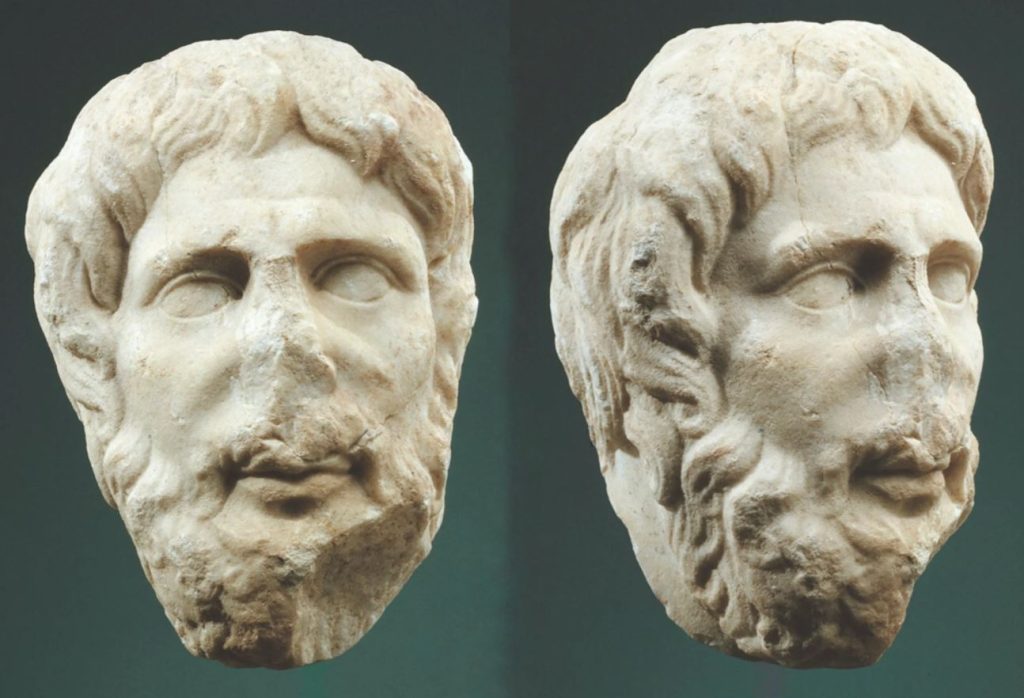
Ataegina, the goddess of fertility and earth symbolizing abundance, often connected with Endovelico.
Ataegina was worshiped in Lusitania; there were also sanctuaries dedicated to Ataegina in Elvas, Portugal, and Mérida and Cáceres in Spain, along with other places, especially near the Guadiana river. She was one of the goddesses worshiped in Myrtilis, today’s Mértola, Portugal, Beja, Portugal and especially the city of Turobriga, whose precise location is unknown.
The name Ataegina is most commonly derived from a Celtic source: the two roots atte- and geno- to mean “Reborn”. Epigraphs from the Badajoz region associate the goddess with presiding over Spring and seasonality, echoing the “reborn” derivation of the name. A bronze plaque from Malpartida de Cáceres suggests associations with the goat as a sacred animal.
Epone – a protector of horses, donkeys, and mules. She was particularly a goddess of fertility, as shown by her attributes of a patera, cornucopia, ears of grain and the presence of foals in some sculptures.
Duberdico – is a Lusitanian diety, central in the cultural area of Lusitania, in the territory of modern Portugal. Duberdico has historically been associated as a water and ocean god, equivalent to Poseidon, venerated as a god of water, fountains, lakes and the ocean as water was a symbol of life and prosperity. Lusitanians have a strong connection to the ocean. Duberdico is often depicted as holding a trident which is a symbol associated with strength in the ocean and fishing.
Nabia – the goddess of freshwaters, associated with earth and sacred springs, the deity of water, fountains and rivers. Her name still endures in the region through the Navia River and the Fountain of the Idol in northern Portugal.
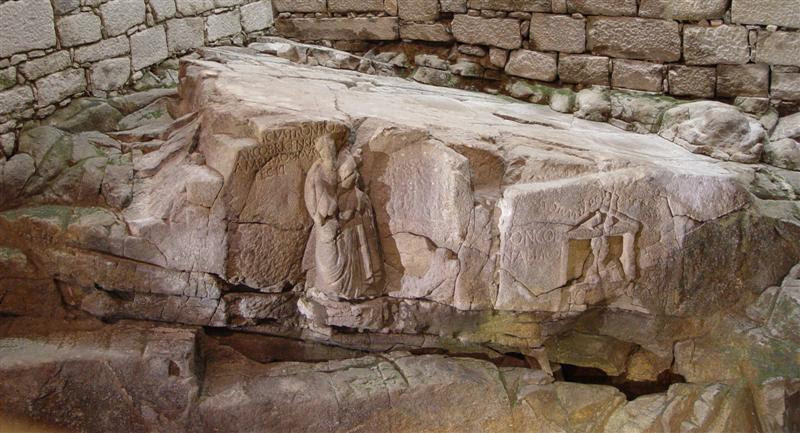
The Fountain of the Idol dedicated to the water godess Nabia can be found at São José de São Lázaro, in the municipality of Braga.
Bandua – associated with war and hunting. The name appears in numerous dedications and often linked to a town or a location (e.g. Bandua Roudaeco, Bandua Etobrico or Bandua Brealiacui). The deity was the protector of the local community. in one dedication is considered a god of the war flag or standard. Appears to have enjoyed great success among the Celts of Braga.
Cosso – warrior god who attained great popularity among the Celts in southern Galicia, and was one of the most revered.
Berobreo – god of the Otherworld and beyond. The largest shrine dedicated to this deity documented until now, stood in the fort of the Torch of Donón in Galicia.
Bormanico – god of hot springs.
Suleviae – generally understood as mother goddesses and as personal or household protectors. The Suleviae were worshipped in parts of ancient Iberia, particularly in the region known as Galicia. This area corresponds to parts of modern-day northwest Spain and northern Portugal. Archaeological findings, including inscriptions and dedications, provide evidence of the Suleviae’s worship.
Taranis – a significant deity among the Celts, associated with thunder and weather. Equivalent to Zeus of the Greeks and Jupiter. His worship in the Iberian Peninsula reflects the broader Celtic religious practices that were prevalent across Europe during ancient times and is supported by archaeological findings, particularly altars dedicated to him that have been discovered in regions such as Spain and Portugal.
Lugu (Lucubo,Lugus) – god of prosperity, trade and craft occupations; his figure is associated with the spear and is one of the most common among the Celts. Many place names are derived from it throughout Celtic Europe.
Belenos (Belenus) – Belenos is an ancient Celtic God of Sun, healing and therapeutic springs.
Lenus – Lenus was a Celtic healing god worshipped chiefly by the Treveri, associated with war and healing. His main sanctuaries were located in the Moselle valley, particularly at Trier, where he was honoured as a protector and healer.
Trebarouna – is a Celtic goddess associated with the home and protection. She is associated with another, male deity named Reve. Her worship was primarily located in the regions of Portugal and Galicia, with various Celtic language inscriptions and altars dedicated to her found in these areas.
Cernunnos – Cernunnos is a Celtic god associated with nature, fertility, and wild animals, often depicted with antlers and a torc.
Toutatis – Toutatis, is a Celtic god associated with tribes. He was often linked to human sacrifices and was considered a protector of the tribe.
Sucellus – Sucellus is a powerful Celtic god associated with agriculture, wine, and protection, often depicted carrying a large mallet and a barrel.
Kontebria – is a sun goddess from Lusitanian Celtic mythology in the region of Cantabria. The reverence for Kontebria indicates a continuity of sun worship in the region, which persisted during the ages.
Festivals and ceremonies dedicated to specific deities were an important part of the religious life of the Celts. These events were often tied to the agricultural calendar, with rituals designed to ensure the fertility of the land and the protection of crops. For example, festivals dedicated to Nabia might have been held in the spring, when the rivers and springs were at their fullest, to invoke the goddess’s blessing for a bountiful harvest.
These festivals typically involved processions, music, dance, and the offerings. The community would come together to celebrate the gods and renew their commitment to the shared religious practices that bound them together. Such festivals also served as an opportunity to strengthen social ties and reinforce the communal identity.
Celtic religion reflects a complex interplay of indigenous beliefs and influences from nature, showcasing a vibrant spiritual life that persisted through the ages.
Celtic Druids and Philosophy
Clement of Alexandria, a 2nd-century writer, claimed that philosophy flourished among “barbarians” first, asserting that Celtic Druids influenced Pythagorean philosophy.
“Thus philosophy, a thing of the highest utility, flourished in antiquity among the barbarians, shedding its light over the nations. And afterwards it came to Greece. First in its ranks were the prophets of the Egyptians; and the Chaldeans among the Assyrians; and the Druids among the Gauls; and the Samanseans among the Bactrians; and the philosophers of the Celts.”Clement of Alexandria, The Writings of Clement of Alexandria, book 1, chapter 15
Polyhistor, 1st-century BC writer, in his book On Pythagorean Symbols, also reports that Pythagoras was a student of several knowledgeable barbarians including the Druids.
“Yet, indeed, not all barbarians are simply savage, but some, to some extent, attain to goodness and fairness, so as even to obtain a name worthy of admiration. Alexander surnamed Polyhistor recounts in his work On Pythagorean Symbols that Pythagoras, an Assyrian by race, was a pupil of Zoroaster. And those called prophets also pursued philosophy among the Egyptians, and likewise among the Assyrians the Chaldeans, and among the Gauls the Druids, and from Bactria in Persia the Samanai, and not a few of the Celts, and among the Persians the Magi, and among the Indians the Gymnosophists, and Anacharsis himself among the Scythians, and Zalmoxis in Thrace.” Polyhistor, On Pythagorean Symbols, chapter 27
Pythagoras and the Druids did share some similar beliefs.
- Transmigration of Souls: Both Pythagoras and the Druids believed in the concept of the soul’s immortality and its ability to reincarnate into different forms, including animals and plants.
- Philosophical Traditions: Both groups maintained a strong oral tradition, with teachings passed down through generations rather than written down.
The philosophies of the Druids and Pythagoras exhibited notable similarities, particularly regarding the nature of the soul. Pythagoras was also reported by Iamblichus, 3rd-century AD writer, in his Life of Pythagoras, to have studied under the different philosophers including those of the Celts and Iberians.Iamblichus, Life of Pythagoras, chapter 28
As per Diogenes:
“Some say that the study of philosophy originated with the barbarians…among the Celts and Gauls men who were called Druids and Semnethei. as Aristotle relates in his book on Magic, and Sotion in the twenty-third book of his Succession of Philosophers.”Diogenes Laërtius, The Lives and Opinions of Eminent Philosophers, book 1, chapter 1
“But they who say that philosophy had its rise among the barbarians, give also an account of the different systems prevailing among the various tribes. And they say that the Gymnosophists and the Druids philosophize, delivering their apophthegms in enigmatical language, bidding men worship the gods and do no evil, and practise manly virtue.”Diogenes Laërtius, The Lives and Opinions of Eminent Philosophers, book 1, chapter 5
Druids held significant power and respect within their communities. We also know Roman emperors were consulting with Druids up to the 3rd century AD.
“It seems quite remarkable what is reported that, once it was found out by Diocletian, he said to Asclepiodotus Colfino, his counselor, but about this posterity will judge. For he said that at a certain time Aurelian had consulted the Gallic Druids, inquiring whether the empire would remain in his descendants; then he said that they replied, Aelius will have a greater name in the state than the successors of Claudius. And indeed Constantius is now Emperor of the same blood, whose descendants, I think, will attain to that glory which was foretold by the Druids. I therefore include this in the life of Aurelian, because these answers were given to Aurelian himself when he consulted them.”Flavius Vopiscus, Historia Augusta, Divus Aurelianus, chapter 44
“to place a little story about Diocletian Augustus in this fitting place, which was given to him at the beginning of his rule. My grandfather told me, having learned it from Diocletian himself. When, he said, Diocletian was staying at an inn among the Tungri in Gaul, still serving in lower ranks, and was reckoning the cost of his daily fare with a certain woman who was a Druidess, and she said, “Diocletian, you are too greedy and too sparing; you are not joking seriously,” Diocletian is said to have replied, “I will then be generous when I am Emperor.” After this remark, the Druidess is said to have replied, “Diocletian, do not jest: for you will be Emperor when you kill a boar.” Flavius Vopiscus, Historia Augusta, Numeriunus, chapter 13
“From that time on Diocletian always had in his mind a desire for the imperial power, and Maximian knew it, as did my grandfather, to whom the saying had been reported by the Druid himself. Finally, as he was a serious man, he laughed and kept silent. Yet in hunting, whenever there was an opportunity, he always killed boars with his own hand. Finally, when Aurelian had taken the empire, then Probus, then Tacitus, and then Carus himself, Diocletian said, “I always kill the boars, but someone else always enjoys the meat.” Now it is well known and commonly reported that, when he had killed the Boar, the Praetorian Prefect, he is said to have remarked, “At last I have killed the fated Boar.” My grandfather used to say that Diocletian himself had said that he had no other reason for killing the Boar with his own hand than to fulfill the Druid’s prophecy and to secure his own rule; for he did not wish to make himself known as so cruel in the very first and especially important days of his reign, unless necessity drew him to this atrocity of killing. “Flavius Vopiscus, Historia Augusta, Carinus, chapter 14
More as per Diogenes:
“Among all the Gallic peoples, generally speaking, there are three sets of men who are held in exceptional honour; the Bards, the Vates and the Druids. The Bards are singers and poets, the Vates, diviners and natural philosophers, while the Druids, in addition to natural philosophy, study also moral philosophy. The Druids are considered the most just of men and on this account they are entrusted with the decision, not only of private disputes, but of the public disputes as well, so that in former times they even arbitrated in cases of war and made the opponents stop when they were about to line up for battle, and the murder cases in particular had been turned over to them for decision. However not only the Druids, but others as well, say that men’s souls and also the universe are indestructible although both fire and water will at some time or other prevail over them.”Strabo, Geographia, book 4, chapter 4.3-4
As per Diodorus Siculus:
“Philosophers, as we may call them, and men learned in religious affairs are unusually honoured among them and are called by them Druids.”Diodorus Siculus, Library of History, book 5, Chapter 31.2-5
As per Cicero:
” Nor is the practice of divination disregarded even among uncivilized tribes, if indeed there are Druids? in Gaul—and there are, for I knew one of them myself, Divitiacus the Aeduan, your guest and eulogist. He claimed to have that knowledge of nature which the Greeks call physiologia, and he used to make predictions, sometimes by means of augury and sometimes by means of conjecture.”Cicero, De Divinatione, I. xli. 90—xlii
As per Pliny the Elder:
“Upon this occasion we must not omit to mention the admiration that is lavished upon this plant by the Gauls. The Druids—for that is the name they give to their magicians—held nothing more sacred than the mistletoe and the tree that bears it, supposing always that tree to be the robur. Of itself the robur is selected by them to form whole groves, and they perform none of their religious rites without employing branches of it; so much so, that it is very probable that the priests themselves may have received their name from the Greek name for that tree. In fact, it is the notion with them that everything that grows on it has been sent immediately from heaven, and that the mistletoe upon it is a proof that the tree has been selected by God himself as an object of his especial favour.
The mistletoe, however, is but rarely found upon the robur; and when found, is gathered with rites replete with religious awe. This is done more particularly on the fifth day of the moon, the day which is the beginning of their months and years, as also of their ages, which, with them, are but thirty years. This day they select because the moon, though not yet in the middle of her course, has already considerable power and influence; and they call her by a name which signifies, in their language, the all-healing. Having made all due preparation for the sacrifice and a banquet beneath the trees, they bring thither two white bulls, the horns of which are bound then for the first time. Clad in a white robe the priest ascends the tree, and cuts the mistletoe with a golden sickle, which is received by others in a white cloak. They then immolate the victims, offering up their prayers that God will render this gift of his propitious to those to whom he has so granted it. It is the belief with them that the mistletoe, taken in drink, will impart fecundity to all animals that are barren, and that it is an antidote for all poisons. Such are the religious feelings which we find entertained towards trifling objects among nearly all nations.”Pliny the Elder, Natural History, book 16, chapter 95
“Similar to savin is the herb known as “selago.” Care is taken to gather it without the use of iron, the right hand being passed for the purpose through the left sleeve of the tunic, as though the gatherer were in the act of committing a theft. The clothing too must be white, the feet bare and washed clean, and a sacrifice of bread and wine must be made before gathering it: it is carried also in a new napkin. The Druids of Gaul have pretended that this plant should be carried about the person as a preservative against accidents of all kinds, and that the smoke of it is extremely good for all maladies of the eyes.”Pliny the Elder, Natural History, book 24, chapter 62
“The Druids, also, have given the name of “samolus” to a certain plant which grows in humid localities. This too, they say, must be gathered fasting with the left hand, as a preservative against the maladies to which swine and cattle are subject. The person, too, who gathers it must be careful not to look behind him, nor must it be laid anywhere but in the troughs from which the cattle drink.”Pliny the Elder, Natural History, book 24, chapter 63
“In addition to the above, there is another kind of egg, held in high renown by the people of the Gallic provinces, but totally omitted by the Greek writers. In summer time, numberless snakes become artificially entwined together, and form rings around their bodies with the viscous slime which exudes from their mouths, and with the foam secreted by them: the name given to this substance is “anguinum.” The Druids tell us, that the serpents eject these eggs into the air by their hissing, and that a person must be ready to catch them in a cloak, so as not to let them touch the ground; they say also that he must instantly take to flight on horseback, as the serpents will be sure to pursue him, until some intervening river has placed a barrier between them. The test of its genuineness, they say, is its floating against the current of a stream, even though it be set in gold. But, as it is the way with magicians to be dexterous and cunning in casting a veil about their frauds, they pretend that these eggs can only be taken on a certain day of the moon; as though, forsooth, it depended entirely upon the human will to make the moon and the serpents accord as to the moment of this operation.
I myself, however, have seen one of these eggs: it was round, and about as large as an apple of moderate size; the shell of it was formed of a cartilaginous substance, and it was surrounded with numerous cupules, as it were, resembling those upon the arms of the polypus: it is held in high estimation390 among the Druids. The possession of it is marvellously vaunted as ensuring success in law-suits, and a favourable reception with princes; a notion which has been so far belied, that a Roman of equestrian rank, a native of the territory of the Vocontii, who, during a trial, had one of these eggs in his bosom, was slain by the late Emperor Tiberius, and for no other reason, that I know of, but because he was in possession of it. It is this entwining of serpents with one another, and the fruitful results of this unison, that seem to me to have given rise to the usage among foreign nations, of surrounding the caduceus with representations of serpents, as so many symbols of peace—it must be remembered, too, that on the caduceus, serpents are never represented as having crests.”Pliny the Elder, Natural History, book 29, chapter 12
“The Gallic provinces, too, were pervaded by the magic art, and that even down to a period within memory; for it was the Emperor Tiberius that put down their Druids, and all that tribe of wizards and physicians. But why make further mention of these prohibitions, with reference to an art which has now crossed the very Ocean even, and has penetrated to the void recesses of Nature? At the present day, struck with fascination, Britanny [France] still cultivates this art, and that, with ceremonials so august, that she might almost seem to have been the first to communicate them to the people of Persia. To such a degree are nations throughout the whole world, totally different as they are and quite unknown to one another, in accord upon this one point!”Pliny the Elder, Natural History, book 30, chapter 4
As per Pomponius Mela:
“The proud and superstitious peoples are sometimes so savage that they believe a human being to be the best and most pleasing victim for the gods. Traces of their now-abolished barbarity remain, and although they refrain from the most extreme slaughters, nevertheless, when they bring the devoted near to the altars, they taste (of them). Yet they also have their own eloquence and teachers of wisdom, the Druids.”Pomponius Mela, De Situ Orbis, book 3, Chapter 14
“They [Druids] profess to know the size and form of the earth and of the universe, the movements of the sky and the stars, and what the gods will. They teach many things to the noblest men of the people, secretly and for a long time, for twenty years at a time, either in a cave or in hidden groves. One thing from what they teach has flowed out among the common people: evidently so that they would be better for wars, they teach that souls are eternal and that there is another life among the dead. And so, they burn and bury with the dead things suited to the living. In old times even the accounting of business and the collection of debt were deferred to the lower world, and there were some who willingly threw themselves onto the pyres of their own people, as if they were going to live with them together.”Pomponius Mela, De Situ Orbis, book 3, Chapter 15
As per Suetonius:
“He [Claudius] utterly abolished the cruel and inhuman religion of the Druids among the Gauls, which under Augustus had merely been prohibited to Roman citizens.”Suetonius, Life of Claudius, Chapter 25
As per Ammianus Marcellinus:
“Ancient writers, pursuing their investigations into the earliest origin of the Gauls, left our knowledge of the truth very imperfect; but at a later period, Timagenes, a thorough Greek both in diligence and language, collected, from various writings facts which had been long unknown, and guided by his faithful statements, we, dispelling all obscurity, will now give a plain and intelligible relation of them.
Some persons affirm that the first inhabitants ever seen in these regions were called Celts, after the name of their king, who was very popular among them, and sometimes also Galatæ, after the name of his mother. For Galatæ is the Greek translation of the Roman term Galli.
The Druids affirm that a portion of the people was really indigenous to the soil, but that other inhabitants poured in from the islands on the coast, and from the districts across the Rhine, having been driven from their former abodes by frequent wars, and sometimes by inroads of the tempestuous sea.”Ammianus Marcellinus, Roman History, book 9, Chapter 2-4
“Throughout these provinces, the people gradually becoming civilized, the study of liberal accomplishments flourished, having been first introduced by the Bards, the Eubages, and the Druids. The Bards were accustomed to employ themselves in celebrating the brave achievements of their illustrious men, in epic verse, accompanied with sweet airs on the lyre. The Eubages investigated the system and sublime secrets of nature, and sought to explain them to their followers. Between these two came the Druids, men of loftier genius, bound in brotherhoods according to the precepts and example of Pythagoras; and their minds were elevated by investigations into secret and sublime matters, and from the contempt which they entertained for human affairs they pronounced the soul immortal.”Ammianus Marcellinus, Roman History, book 9, Chapter 8
As per Tacitus:
“On the beach stood the adverse array, a serried mass of arms and men, with women flitting between the ranks. In the style of Furies, in robes of deathly black and with disheveled hair, they brandished their torches; while a circle of Druids, lifting their hands to heaven and showering imprecations, struck the troops with such an awe at the extraordinary spectacle that, as though their limbs were paralysed, they exposed their bodies to wounds without an attempt at movement. Then, reassured by their general, and inciting each other never to flinch before a band of females and fanatics, they charged behind the standards, cut down all who met them, and enveloped the enemy in his own flames.”Tacitus, Annals, book 14, chapter 30
“Once long ago Rome was captured by the Gauls, but since Jove’s home was unharmed, the Roman power stood firm now this fatal conflagration has given a proof from heaven of the divine wrath and presages the passage of the sovereignty of the world to the peoples beyond the Alps. Such were the vain and superstitious prophecies of the Druids.”Tacitus, Histories, book 4, chapter 54
As per Caesar:
“Throughout al Gaul there are two orders of those men who are of any rank and dignity: for the commonality is held almost in the condition of slaves, and dares to undertake nothing of itself and is admitted to no deliberation. The greater part, when they are pressed either by debt, or the large amount of their tributes, or the oppression of the more powerful, give themselves up in vassalage to the nobles, who possess over them the same rights without exception as masters over their slaves. But of these two orders, one is that of the Druids, the other that of the knights.
The former are engaged in things sacred, conduct the public and the private sacrifices, and interpret all matters of religion. To these a large number of the young men resort for the purpose of instruction, and they [the Druids] are in great honour among them. For they determine respecting almost a l controversies, public and private; and if any crime has been perpetrated, if murder has been committed, if there be any dispute about an inheritance, if any about boundaries, these same persons decide it; they decree rewards and punishments if any one, either in a private or public capacity, has not submitted to their decision, they interdict him from the sacrifices. This among them is the most heavy punishment.
Those who have been thus interdicted are esteemed in the number of the impious and the criminal: all shun them, and avoid their society and conversation, lest they receive some evil from their contact; nor is justice administered to them when seeking it, nor is any dignity bestowed on them. Over all these Druids one presides, who possesses supreme authority among them. Upon his death, if any individual among the rest is pre-eminent in dignity, he succeeds; but, if there are many equal, the election is made by the suffrages of the Druids; sometimes they even contend for the presidency with arms.
These assemble at a fixed period of the year in a consecrated place in the territories of the Carnutes, which is reckoned the central region of the whole of Gaul. Hither all, who have disputes, assemble from every part, and submit to their decrees and determinations. This institution is supposed to have been devised in Brittany [France], and to have been brought over from it into Gaul; and now those who desire to gain a more accurate knowledge of that system generally proceed thither for the purpose of studying it.”Caesar, Commentarii de Bello Gallico, book 6, chapter 13
“The Druids do not go to war, nor pay tribute together with the rest; they have an exemption from military service and a dispensation in a l matters. Induced by such great advantages, many embrace this profession of their own accord, and [many] are sent to it by their parents and relations. They are said there to learn by heart a great number of verses; accordingly, some remain in the course of training twenty years. Nor do they regard it lawful to commit these to writing.
That practice they seem to me to have adopted for two reasons; because they neither desire their doctrines to be divulged among the mass of the people, nor those who learn, to devote themselves the less to the efforts of memory, relying on writing; since it generally occurs to most men, that, in their dependence on writing, they relax their diligence in learning thoroughly, and their employment of the memory.
They wish to inculcate this as one of their leading tenets, that souls do not become extinct, but pass after death from one body to another, and they think that men by this tenet are in a great degree excited to valour, the fear of death being disregarded. They likewise discuss and impart to the youth many things respecting the stars and their motion, respecting the extent of the world and of our earth, respecting the nature of things, respecting the power and the majesty of the immortal gods.”Caesar, Commentarii de Bello Gallico, book 6, chapter 14
“The nation of al the Gauls is extremely devoted to superstitious rites; and on that account they who are troubled with unusually severe diseases and they who are engaged in battles and dangers, either sacrifice men as victims, or vow that they will sacrifice them, and employ the Druids as the performers of those sacrifices; because they think that unless the life of a man be offered for the life of a man, the mind of the immortal gods cannot be rendered propitious, and they have sacrifices of that kind ordained for national purposes. Others have figures of vast size, the limbs of which formed of osiers they fil with living men, which being set on fire, the men perish enveloped in the flames. They consider that the oblation of such as have been taken in theft, or in robbery, or any other offence, is more acceptable to the immortal gods; but when a supply of that class is wanting, they have recourse to the oblation of even the innocent.”Caesar, Commentarii de Bello Gallico, book 6, chapter 16
“They worship as their divinity, Mercury [Celtic Lugu] in particular, and have many images of him, and regard him as the inventor of all arts, they consider him, the guide of their journeys and marches, and believe him to have very great influence over the acquisition of gain and mercantile transactions. Next to him they worship Apollo [Celtic Belenos], and Mars [Celtic Lenus], and Jupiter [Celtic Taranis], and Minerva [Celtic Suleviae].”Caesar, Commentarii de Bello Gallico, book 6, chapter 17
“All the Gauls assert that they are descended from the god Dis, and say that this tradition has been handed down by the Druids. For that reason they compute the divisions of every season, not by the number of days, but of nights; they keep birthdays and the beginnings of months and years in such an order that the day follows the night.”Caesar, Commentarii de Bello Gallico, book 6, chapter 18
As per Lucan:
“The Bards also, who by the praises of their verse transmit to distant ages the fame of heroes slain in battle, poured forth at ease their lays in abundance. And the Druids, laying down their arms, went back to the barbarous rites and weird ceremonies of their worship. (To them alone is granted (knowledge—or ignorance, it may be —of gods and celestial powers; they dwell in deep forests with sequestered groves; they teach that the soul does not descend to the silent land of Erebus and the sunless realm of Dis below, but that the same breath still governs the limbs in a different scene. If their tale be true, death is but a point in the midst of continuous life.”Lucan, Pharsalia, book 1, chapter 450
Celtic Weddings
Celtic weddings were said to have been similar to that of Greek weddings.
“They marry in the same way as the Greeks. “Strabo, Geographia, book 3, chapter 3.7
Ancient Celtic weddings were primarily arranged for social responsibility and reproduction, often lacking legal recognition while Roman weddings were more formalized. Celtic marriages emphasized the union of households.
Celtic marriages were typically arranged by parents or matchmakers; the focus was on producing legitimate heirs and strengthening family ties. The ceremony lacked formal legal documentation, relying instead on family witnesses. Celts focused on social obligations.
“for instance, it is the custom among the Cantabrians for the husbands to give dowries to their wives, for the daughters to be left as heirs, and the brothers to be married off by their sisters”Strabo, Geographia, book 3, chapter 4.18
Celtic Cultural Art and Craftsmanship
The art of the Celts traces its roots from the Atlantic Bronze Age culture of the Lusitanian region, this culture eventually spread throughout central and eastern Europe. Celtic artwork and craftsmanship is quite well known for its ornaments made of bronze, as well as weaponry and iron tools of very high quality.
Typically, the overarching themes of Celtic artworks and sculptures are complex symbolism, ornamental geometric designs, and non-linear patterns.


Celtic Lunulas – Chao de Lamas Coimbra, Portugal – 2nd Century BC
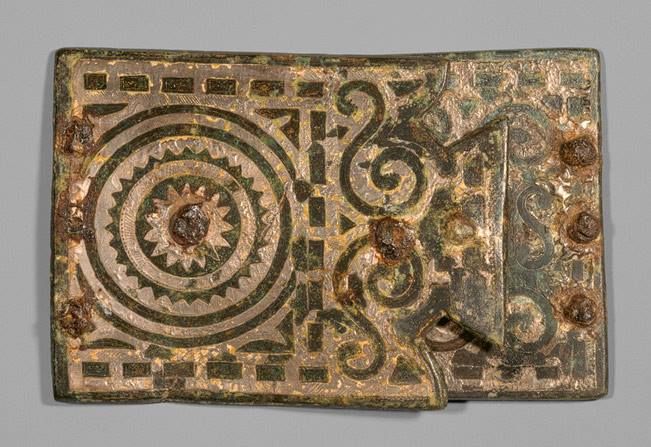
Celtiberian buckle – 2nd Century BC


Oceanic Nagivation by the Celts of Lusitania
Since ancient times the Celts from Lusitania and Galicia routinely navigated to other lands and islands, their maritime skills suggest they were adept at using local knowledge and traditional methods to navigate the Atlantic Ocean.
Celtic maritime explorations resulted in numerous territories and maritime routes recorded by the Lusitanian Portuguese on journeys during the 14th, 15th and 16th centuries. The Canary Islands were discovered by the Portuguese in 1320 under King Dinis, The Madeira Islands in 1419, the Azores in 1427, the Cape Verde Islands in 1456 and the Sao Tome e Principe Islands in 1470. All islands except the Canary Islands were uninhabited.
Lusitanian sailors were at the vanguard of European exploration, chronicling and mapping the coasts of Greenland, Canada, America, Brazil, Africa, India, Asia including China, Japan, and Australia in what became known as Portugal’s Age of Discovery.
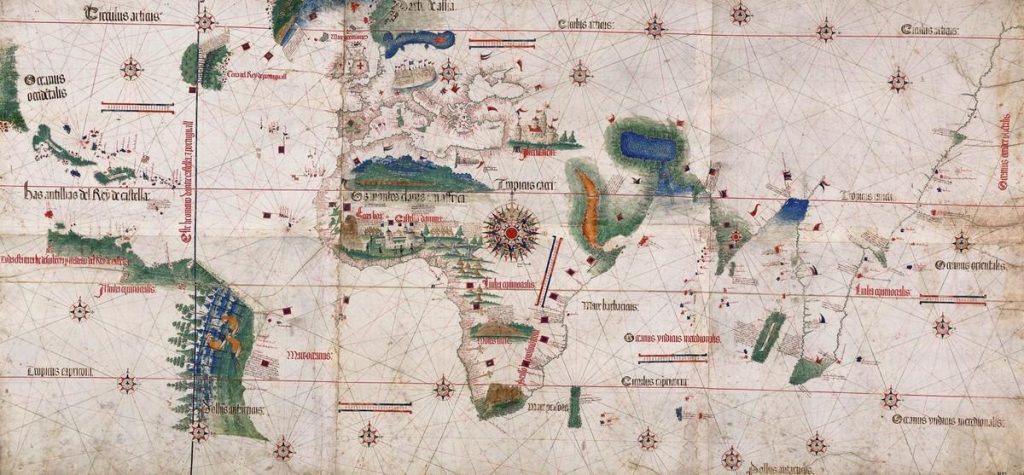
The Celtiberian Castillians soon followed the Lusitanians and the 1479 Treaty of Alcáçovas was signed by both Celtic nations. This treaty between Portugal and Castille allowed the Portuguese to remain in possession of the newly discovered islands of Madeira and Azores and any lands south of the Canary Islands which would themselves remain in the possession of the Castillians.
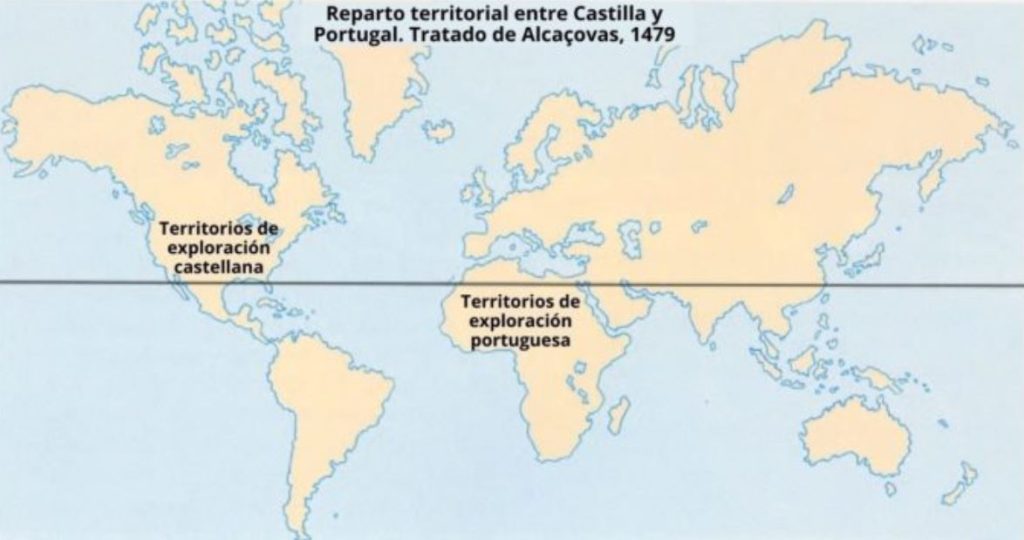
This agreement was for all newly discovered territory south of the Canary Islands to remain under Portuguese authority while any newly discovered lands to the north of the Canary Islands line would remain under Spanish authority – with the Azores and Madeira Islands being the exception as they were already occupied by the Portuguese. This treaty was created so as to avoid another war between both Celtic nations.
Celts Arrive in the Americas
The Americas was discovered by the Portuguese before 1424. Issues between both Celtic nations – Portugal and Castille, commenced when the Portuguese navigator Cristóbal Colón, born in the village of Cuba, Alentejo landed on the island of San Salvador in the Bahamas in 1492. Cristóbal was at the time under the sponsorship of the king of Castille having supposedly failed to initially obtain sponsorship from the Portuguese King John II.
There is evidence Cristóbal was a double agent sent by King John II of Portugal to the Castillians to ensure the Spanish crown never discovered the true route to India. Instead Cristóbal misled the Castillians on a voyage to lands in the new world, namely the Bahamas which had already been discovered by the Portuguese, which was south of the 1479 Treaty of Alcáçovas line and of little value. At the time there wasn’t much to trade with in the east coast of the new world when compared to the gold trade in Ghana and the spice markets of India. Upon Cristóbal’s return to Castille he purposely misinformed the Spanish crown claiming he had reached India, bringing back with him a couple of natives from the Bahamas calling them Indians when in fact they were not true Indians. By this method Portugal was able to keep its long time rival from accessing the gold trade in Ghana and spice trade via the Cape of Good Hope for several more centuries. Credit: Dr Manuel da Silva Rosa, Portugal e o Segredo de Colombo
Since the Bahamas were south of the Canary Islands agreed Treaty of Alcáçovas demarcation line, King John II claimed the lands for Portugal. However the Castillians were far from happy to relinquish these lands, thinking they formed part of India.
King John II of Portugal then offered Castille a new treaty whereby a new line of demarcation would be drawn from North to South 370 leagues (1500km) off the Cape Verde Islands to the west. The Portuguese were to remain east of the line and the Spanish to the west of the line.
The Spanish crown accepted this new treaty believing they would continue to have access to the lucrative Indian spice trade when in fact they had merely landed in the Bahamas. This misconception is why native Americans were initially called Indians by the Spanish and then rest of the world. This new treaty was to be signed in 1494 and named the Treaty of Tordesillas.
The Portuguese explorer Bartolomeu Dias had already secretly rounded the Cape of Good Hope, the southern tip of Africa, in February 1488. Therefore the genuine trade route to India, Asia and the lucrative spice trade was open to the Portuguese at least six years before the Treaty of Tordesillas was signed in 1494.
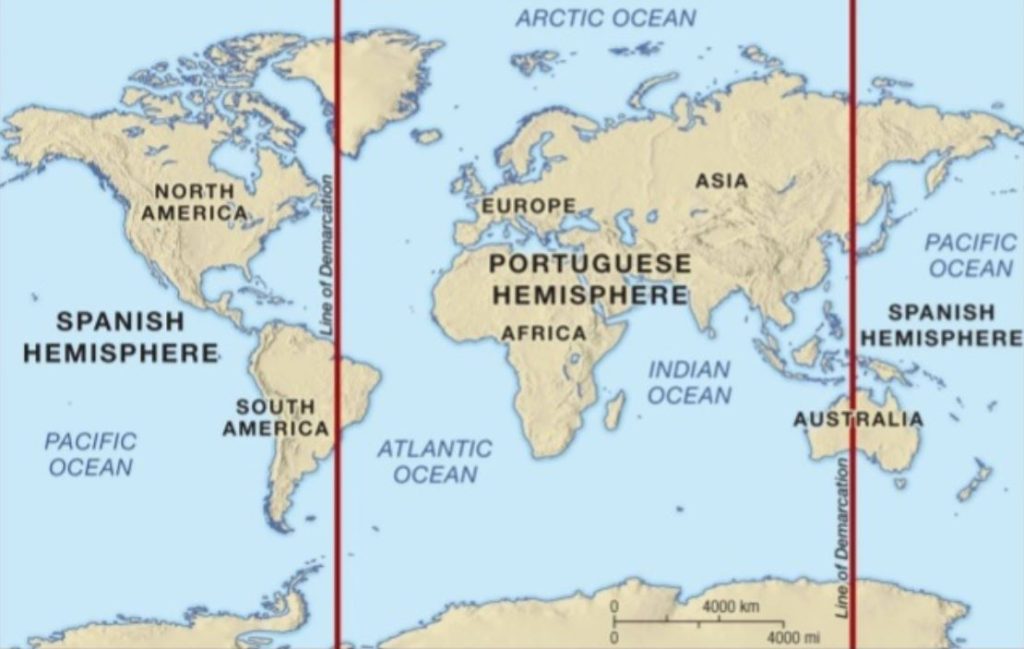
Officially though, the maritime spice trade between Asia and Europe commenced a few years later when the Portuguese explorer Vasco da Gama, building on the the previous discoveries made by the explorer Bartolomeu Dias, arrived in India on May 20, 1498. This voyage was a pivotal moment in the Age of Discovery, opening up new trade routes between Europe and Asia. Only when the Portuguese explorer Ferdinand Magellan arrived in the Phillipines in 1521 and the Spaniard Miguel López de Legazpi established the first permanent Spanish settlement in Cebu were the Spaniards able to enter the spice trade with Asia. By then the Portuguese had established several maritime ports and trading posts along the African and Asian continents ensuring a maritime trade monopoly between Europe and Asia which lasted several hundred years.
The temporary 1580-1640 union of Portugal’s and Spain’s empires is where the term “The Empire on which the sun never sets” derives from. The 1494 Treaty of Tordesillas lasted till 1750.
How useful was this post?
Click on a star to rate it!
Average rating 0 / 5. Vote count: 0
No votes so far! Be the first to rate this post.
admin@celthistory.com